
If you ask most Nigerians who owns NNPC, they’ll give you the short answer: “The government.” And they’re not wrong. But the real answer is more precise now than it ever was before.
Before 2021, the government owned NNPC because the NNPC Act said so. That was it. No shares. No certificates. No formal structure.
After the Petroleum Industry Act, everything changed. NNPC Limited has actual shares. Actual shareholders. Actual legal documentation. The government still owns it completely. But now there are shares, share certificates, and shareholder rights.
Here’s who actually owns NNPC Limited, how the structure works, and what it means for Nigerians.
The Short Answer
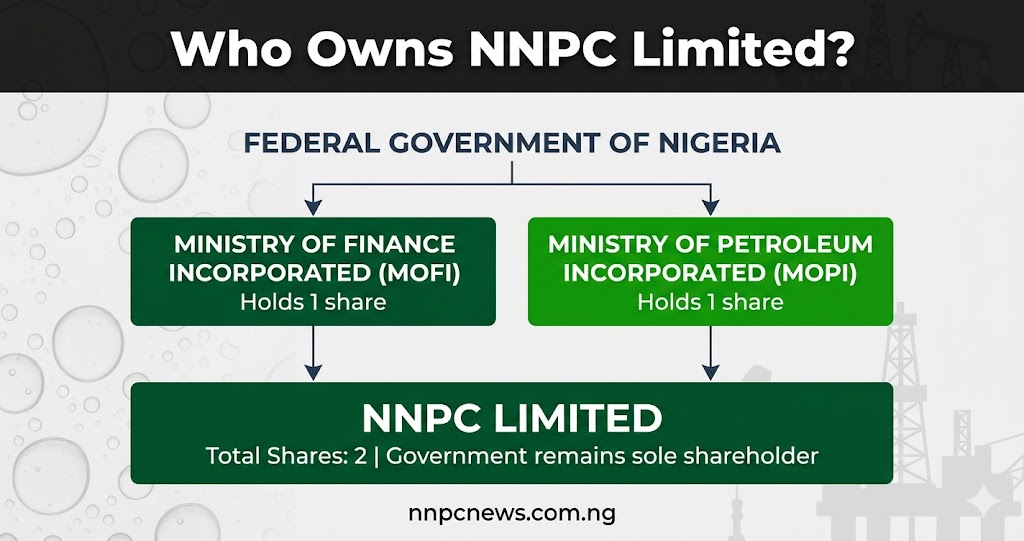
NNPC Limited is wholly owned by the federal government of Nigeria. But unlike the old NNPC, this ownership is formalized through a shareholding structure established under the Petroleum Industry Act 2021.
The shares are held by two entities:
- Ministry of Finance Incorporated (MOFI) — holds one share
- Ministry of Petroleum Incorporated (MOPI) — holds one share
Both hold these shares on behalf of the federation. The government is the sole shareholder. But now there are shares, share certificates, and shareholder rights.
If you’re curious about who owns NNPC Limited, this is the legal answer. And if you want to understand what NNPC Limited is under the Petroleum Industry Act, the ownership structure is the foundation.
The Legal Framework
The Petroleum Industry Act 2021
Section 53 of the PIA mandated the incorporation of NNPC Limited under the Companies and Allied Matters Act. Section 53(2) specified the initial shareholders: MOFI and MOPI, each holding one share on behalf of the federation.
Section 53(5) added an important restriction: the shares cannot be transferred or mortgaged unless approved by the government and the National Economic Council.
Section 55 specifies that NNPC Limited is not subject to the provisions of the NNPC Act or other laws applicable to government agencies.
The Companies and Allied Matters Act 2020
NNPC Limited is registered with the Corporate Affairs Commission under CAMA. This means it has a memorandum and articles of association. It has a board of directors. It has shareholders. It must follow company law.
CAMA defines shareholder rights: voting, dividends, information, and approval of major decisions. These rights apply to MOFI and MOPI as shareholders of NNPC Limited.
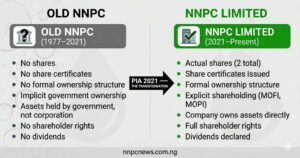
The difference between NNPC and NNPC Limited in ownership terms is stark. One was implicit. The other is formal.
The Shareholders
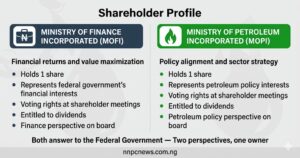
Ministry of Finance Incorporated (MOFI)
MOFI is a statutory corporation established to hold government investments and assets. It’s not a new creation — it’s existed in various forms over the years. Under the PIA, it was designated as one of the two shareholder entities for NNPC Limited.
MOFI’s single share represents the federal government’s financial interests in the company. It participates in shareholder meetings, votes on resolutions, and is entitled to receive dividends when declared.
MOFI focuses on financial returns and value maximization. Its representative on the NNPC Limited board brings a finance perspective.
Ministry of Petroleum Incorporated (MOPI)
MOPI was specifically established under the PIA to hold shares in petroleum sector entities on behalf of the government. It represents the Ministry of Petroleum Resources’ policy interests in NNPC Limited.
Like MOFI, MOPI holds one share with full voting rights and dividend entitlement. It ensures alignment with petroleum policy objectives.
MOPI focuses on policy alignment and sector strategy. Its representative on the board brings a petroleum policy perspective.
Why Two Shareholders?
Having two shareholders rather than one creates balanced representation. Different government interests can be reflected through the two shareholding entities.
MOFI focuses on financial returns and value maximization. MOPI ensures alignment with petroleum policy objectives.
Both ultimately answer to the same government, but the structure forces consideration of different priorities. It’s a governance mechanism, not just paperwork.
The NNPC ownership structure under Nigerian law is designed to balance financial and policy interests.
Share Capital
The Number
NNPC Limited was incorporated with a share capital of ₦200 billion — the highest in Nigeria at the time.
The shares were fully subscribed by the government through MOFI and MOPI. Each paid for its share, and the capital was fully paid at incorporation.
Authorized vs Issued Capital
The authorized share capital is the maximum the company can issue. For NNPC Limited, this was set at ₦200 billion at incorporation.
The issued share capital is what’s actually been given to shareholders. NNPC Limited has issued two shares — one to MOFI and one to MOPI.
The issued capital is fully paid. MOFI and MOPI have paid for their shares in full.
The NNPC share capital explained in detail shows how this works.
The Restriction on Share Transfers
Section 53(5) of the PIA has an important safeguard. The shares cannot be transferred or mortgaged unless approved by the government and the National Economic Council.
This prevents any backdoor privatization without proper oversight. No minister can wake up one morning and decide to sell NNPC shares.
The restriction applies to both MOFI and MOPI. Neither can transfer its share without government and NEC approval.
This provision reflects the strategic importance of NNPC Limited. The government wants to ensure that any change in ownership receives proper consideration.
Comparison with the Old NNPC
Old NNPC: Implicit Government Ownership
The old NNPC was wholly owned by the federal government, but not in the way a company is owned. There were no shares. No share certificates. No formal ownership structure.
The government owned it because the NNPC Act said the government owned it. That was enough for legal purposes. But it made accountability difficult. There was no shareholder to hold management accountable. No dividends to demand. No annual general meetings.
Assets were held by the government directly rather than by a corporate entity. The concept of shareholders and shareholder rights didn’t apply.
NNPC Limited: Formal Shareholding
NNPC Limited has actual shares, an actual share register, and actual shareholder rights. The government’s ownership is documented, structured, and legally enforceable.
This matters for transparency. When someone asks “who owns NNPC,” there’s now a clear answer with legal backing. The shareholding structure is public information. The rights attached to those shares are defined in law.
Asset Ownership Distinction
The old NNPC didn’t own assets in a corporate sense. Assets were held by the government with NNPC as manager. This created ambiguity in ownership and control.
NNPC Limited owns its assets directly. The refineries, pipelines, and other infrastructure are company assets, not government assets held in trust. This enables the company to use assets as collateral, make independent investment decisions, and manage its property portfolio commercially.
What This Means for Nigerians
Nigerians as Beneficial Owners
If the government owns NNPC Limited, and the government is supposed to represent Nigerians, then Nigerians are the ultimate beneficial owners.
The PIA recognizes this. During the inauguration of the NNPC-NEITI joint committee, former GCEO Mele Kyari stated that NNPC was in complete sync with NEITI’s activities because it was “the right of the over 200 million Nigerians who are the shareholders of the corporation to know everything about the operations of their company.”
But beneficial ownership isn’t the same as legal ownership. Nigerians don’t hold shares. They can’t vote at shareholder meetings. They can’t demand dividends. Their ownership is mediated through government.
Transparency Requirements
This is where the transparency provisions of the PIA matter. Section 62 requires annual audit by an independent, qualified auditor. Section 61 requires board members to discharge responsibilities in accordance with the highest standards of corporate governance.
The NNPC financial statements explained in detail show where the money comes from and where it goes. Nigerians can now see the numbers — revenue, costs, profits, and remittances.
Dividend Debate
If the government is the sole shareholder, dividends from NNPC Limited go to the government, not directly to citizens. This is different from models like Alaska’s Permanent Fund, which pays dividends directly to residents.
Some analysts argue that the shareholding structure should be reformed to reflect the three tiers of government. The Revenue Mobilisation Allocation Fiscal Commission has expressed the view that the structure should include states and local governments, not just the executive.
That hasn’t happened yet. For now, dividends flow to the federation account and are distributed through the normal budget process.
Future Ownership Considerations
Potential for Public Offering
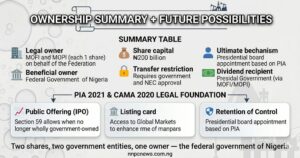
The PIA doesn’t require NNPC Limited to remain wholly government-owned forever. Section 59 contemplates that when the company is no longer wholly government-owned, shareholders will appoint directors differently.
Some analysts expect that NNPC Limited could go public through an Initial Public Offering in the future. This would allow Nigerians and institutional investors to buy shares directly.
But any such move would require significant policy decisions. The current government has shown no inclination to sell shares. The focus has been on improving performance under government ownership, not privatization.
Listing Possibilities
If NNPC Limited were to list shares on the Nigerian Exchange, it would need to meet exchange requirements including enhanced disclosure and governance standards. This could bring additional capital and market discipline.
But listing would also reduce government control. Public shareholders would have rights. The company would need to balance commercial objectives with public accountability. That’s a trade-off no administration has shown interest in making.
Retention of Government Control
For now, complete government control remains the policy. The strategic importance of petroleum resources makes full government ownership politically attractive. It ensures alignment with national interests and prevents private interests from influencing company direction.
The ownership structure under Nigerian law is designed to maintain government control while enabling commercial operations.
Summary: Who Owns What
| Aspect | Detail |
|---|---|
| Legal owner | MOFI (1 share) and MOPI (1 share) |
| Beneficial owner | Federal Government of Nigeria |
| Ultimate beneficiary | Nigerian people (through government) |
| Share capital | ₦200 billion (as at incorporation) |
| Transfer restriction | Requires government and NEC approval |
| Dividend recipient | Federal Government (via MOFI/MOPI) |
| Control mechanism | Presidential appointment of board |
The Conclusion
NNPC Limited is owned by the federal government of Nigeria through two shareholder entities — the Ministry of Finance Incorporated and the Ministry of Petroleum Incorporated. Each holds one share on behalf of the federation. This structure formalizes government ownership in a way the old NNPC never had.
The legal framework comes from two laws: the Petroleum Industry Act 2021 and the Companies and Allied Matters Act 2020. The PIA established the shareholding structure. CAMA provides the corporate governance framework.
Nigerians are the ultimate beneficial owners, but their ownership is mediated through government. The transparency requirements of the PIA — audited accounts, public disclosure, corporate governance — are meant to ensure that this beneficial ownership means something.
Whether NNPC Limited ever sells shares to the public remains an open question. For now, the ownership structure is clear: two shares, two government entities, one owner — the federal government of Nigeria.
Official sources for verification:
- • Petroleum Industry Act 2021 on the FAO Legal Database
- • Corporate Affairs Commission (CAC) Official Website
Last updated: April 2026. Information based on Petroleum Industry Act 2021 provisions, Companies and Allied Matters Act, and official government communications.