
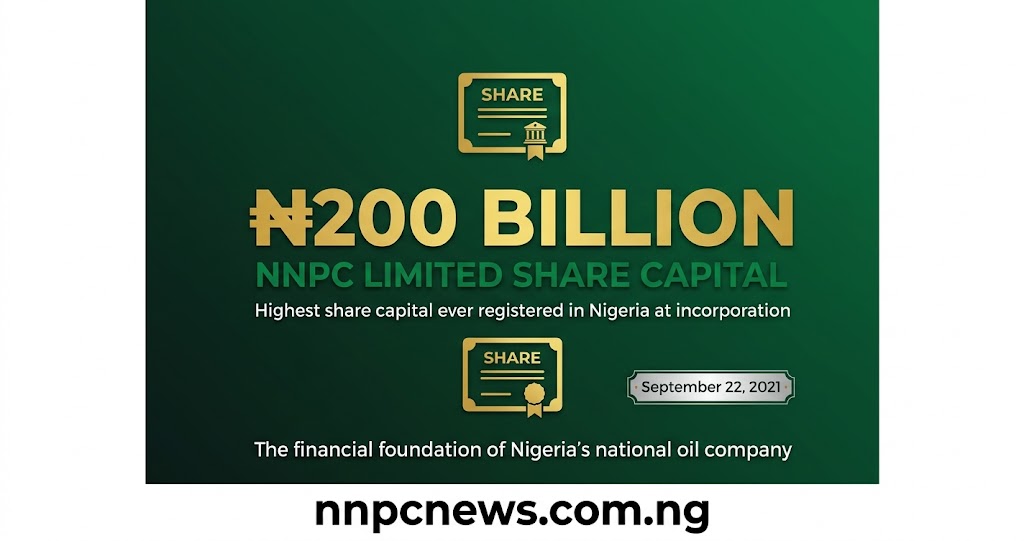
If you’ve ever wondered how much money a national oil company actually needs to get started, the answer for NNPC Limited is ₦200 billion. That’s not a typo.
Two hundred billion naira. At the time of incorporation in September 2021, that made NNPC Limited the company with the highest share capital in Nigeria. Not Dangote. Not MTN. Not any bank. NNPC Limited.
But share capital isn’t just a big number on a certificate. It’s the financial foundation of the company. It tells you how much the owners have committed, what the company can do, and sometimes, what it can’t.
Here’s what NNPC Limited’s share capital actually means, how it compares to everything else in Nigeria, and why it matters beyond the headline.
The Short Answer
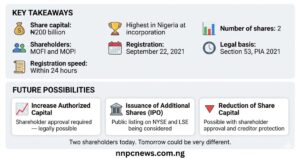
NNPC Limited was incorporated with a share capital of ₦200 billion. This was the highest share capital ever registered for any company in Nigeria at the time.
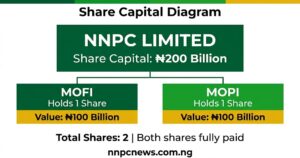
The share capital is divided into two shares. One share is held by the Ministry of Finance Incorporated (MOFI). The other share is held by the Ministry of Petroleum Incorporated (MOPI). Both shares are fully paid.
The share capital is permanent. It cannot be returned to shareholders except through formal capital reduction procedures. It provides the financial foundation for NNPC Limited to operate as a commercial company.
If you’re curious about who owns NNPC Limited, the share capital is divided between its two shareholders. And if you want to understand what NNPC Limited is under the Petroleum Industry Act, the share capital is part of the answer.
What Share Capital Actually Means
Definition
Share capital is the money a company raises by issuing shares to its owners. It’s not a loan. It’s not revenue. It’s permanent capital that stays in the company unless legally returned to shareholders.
When you register a company in Nigeria under the Companies and Allied Matters Act, you must state your share capital. For small businesses, that might be ₦1 million or less. For NNPC Limited, it’s ₦200 billion.
Authorized vs Issued Share Capital
There are two important distinctions.
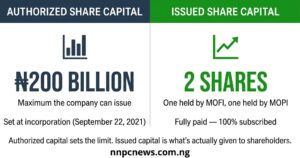
Authorized share capital is the maximum amount of share capital a company is permitted to issue. It is specified in the company’s memorandum and articles of association. For NNPC Limited, the authorized share capital is ₦200 billion.
Issued share capital is the portion of authorized capital that has actually been issued to shareholders. NNPC Limited has issued two shares — one to MOFI and one to MOPI. The issued share capital represents the actual ownership.
Paid-Up Share Capital
Paid-up share capital is the amount shareholders have actually paid for their shares. For NNPC Limited, the issued shares are fully paid. MOFI and MOPI have paid the full value of their shares.
The NNPC share capital explained in detail shows how this works.
NNPC Limited’s Share Capital: The Basics
The Number
NNPC Limited was incorporated on September 22, 2021 with a share capital of ₦200 billion. The Corporate Affairs Commission completed the registration electronically within 24 hours.
At the time, this was the highest share capital ever registered for any company in Nigeria. That’s not a small achievement.
Who Put Up the Money
The share capital was fully subscribed by the government through its two shareholder entities:
- Ministry of Finance Incorporated (MOFI) — holds one share, paid in full
- Ministry of Petroleum Incorporated (MOPI) — holds one share, paid in full
Both entities paid for their shares on behalf of the federation. The government didn’t borrow this money from somewhere else — it committed its own resources to capitalize the new company.
What the PIA Requires
Section 54(9) of the Petroleum Industry Act provides that the initial capitalization of NNPC Limited will not be less than its financial requirements to effectively discharge its commercial duties and deal with its obligations and liabilities transferred to it.
In plain English: the company needed enough money to actually function. The government couldn’t set the share capital at ₦1 million and hope for the best. It had to be realistic.
The difference between NNPC and NNPC Limited is evident in this capitalization. The old NNPC had no share capital. NNPC Limited has ₦200 billion.
How NNPC Limited’s Share Capital Compares
| Company Type | Approximate Share Capital | Context |
|---|---|---|
| NNPC Limited | ₦200 billion | Highest in Nigeria at incorporation |
| Typical large Nigerian bank | ₦10-30 billion | Varies by institution |
| Large telecom company (MTN) | ₦10-20 billion | Estimated |
| Average private company | ₦1-100 million | Depends on business size |
| Small business | ₦100,000 – ₦1 million | Minimum requirements |
The gap is enormous. NNPC Limited’s share capital isn’t just bigger — it’s in a completely different category.
But context matters. A national oil company with refineries, pipelines, joint ventures, and thousands of employees needs substantial capital. The ₦200 billion figure reflected that reality.
The Registration Process
Speed of Registration
The Corporate Affairs Commission registered NNPC Limited within 24 hours of receiving the application. For a company with ₦200 billion share capital, that’s remarkably fast.
The Registrar General of the CAC, Alhaji Garba Abubakar, personally presented the Certificate of Incorporation to President Muhammadu Buhari at the State House in Abuja.
Legal Requirements
Section 53(1) of the PIA required the Minister of Petroleum Resources to cause the incorporation of NNPC Limited within six months of the enactment of the Act, in consultation with the Minister of Finance on the nominal shares of the company.
They met that deadline. The PIA was signed in August 2021. NNPC Limited was incorporated in September 2021. The CAC moved fast, and the government was clearly prioritizing this transition.
What President Buhari Said
At the certificate presentation ceremony, President Buhari charged the management of NNPC Limited to ensure that it was adequately capitalized. He pledged continued support to the company, which he described as strategic to the economic development of the country.
The NNPC ownership structure under Nigerian law was formalized through this registration process.
What Share Capital Means for Operations
No More Government Funding
One of the biggest changes with the transition is funding. Before 2021, NNPC received budgetary allocations from the federal government. It was a government department, so it got government money.
Not anymore.
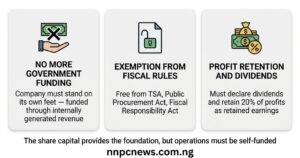
With NNPC Limited now a commercial entity, the federal government will put an end to funding its projects as was obtainable since it was established in 1977. The company must stand on its own feet.
The share capital provides the initial foundation, but ongoing operations must be funded through internally generated revenue and commercial borrowing. That’s a completely different model.
Exemption from Fiscal Rules
President Buhari declared that NNPC Ltd. would henceforth conduct itself under the best international business practice in transparency, governance and commercial viability — free from institutional regulations such as Treasury Single Account, Public Procurement and Fiscal Responsibility Acts.
These exemptions allow the company to operate like a real company rather than a government agency.
Profit Retention and Dividends
The PIA mandates NNPC Limited to conduct its affairs on a commercial basis in line with the Companies and Allied Matters Act. According to the law, the company will run on a commercial basis in a profitable and efficient manner without recourse to government funds and shall declare dividends to shareholders and retain 20 percent of profits as retained earnings, to grow its business.
This is a fundamental shift. The old NNPC didn’t declare dividends. It didn’t retain earnings for growth in any formal sense. It just spent what it had and asked for more when it ran out.
The NNPC financial statements explained show how this new model has performed since the transition.
Could the Share Capital Change?
Increase in Authorized Capital
Companies can increase their authorized share capital by amending their memorandum and articles of association. This requires shareholder approval and compliance with CAMA procedures.
For NNPC Limited, any increase would require the government (through MOFI and MOPI) to approve. There’s no indication this is being considered, but it’s legally possible.
Issuance of Additional Shares
The PIA doesn’t require NNPC Limited to remain wholly government-owned forever. Section 59 contemplates that when the company is no longer wholly government-owned, shareholders will appoint directors differently.
Some analysts expect that NNPC Limited could go public through an Initial Public Offering in the future. This would allow Nigerians and institutional investors to buy shares directly.
If that happens, the share capital would increase significantly. New shares would be issued to public investors, bringing in fresh capital. The government’s percentage ownership would decrease, but the absolute value of the share capital would grow.
Reduction of Share Capital
Companies can reduce share capital under certain circumstances. This requires shareholder approval and compliance with creditor protection requirements.
Capital reduction might be undertaken to eliminate accumulated losses or return capital to shareholders. It is subject to legal safeguards.
NNPC Limited could potentially reduce share capital if circumstances warrant. Any reduction would follow prescribed legal procedures.
The objectives and mandate of NNPC don’t currently contemplate capital reduction, but the legal framework allows for it if shareholders approve.
What This Means for the Federation Account
No More Monthly Remittances
Under the old structure, NNPC would, on a monthly basis, remit oil revenue into government coffers which was shared among the three tiers of government — federal, states, and local governments.
That’s gone.
The new NNPC will no longer remit into the Federation Account Allocation Committee. This invariably means no more money to be shared by state governors in that format.
But Taxes and Royalties Instead
Instead of direct remittances, NNPC Limited now pays:
- Taxes under the Companies Income Tax Act
- Royalties on production
- Dividends to its shareholders (MOFI and MOPI)
The company will pay its share of all fees, rents, royalties, profit oil shares, and taxes and any other required payments to the government.
Former GCEO Mele Kyari put it bluntly: “We are now a private company. Would MTN go to FAAC? We will pay our taxes, we will pay our royalties and we will deliver dividends to our shareholders.”
The NNPC vs FAAC remittances explained shows how this new system works.
Key Takeaways
| Aspect | Detail |
|---|---|
| Share capital at incorporation | ₦200 billion |
| Highest in Nigeria at the time | Yes |
| Number of shares | 2 |
| Shareholders | MOFI (1 share) and MOPI (1 share) |
| Registration date | September 22, 2021 |
| Registration speed | Within 24 hours |
| Legal basis | Section 53, PIA 2021 |
| Government funding going forward | None — company must be self-funding |
| Fiscal rules exemption | TSA, Procurement Act, Fiscal Responsibility Act |
| Profit retention requirement | 20% of profits as retained earnings |
| IPO status | In planning — considering NYSE and LSE listings |
Conclusion
NNPC Limited’s share capital of ₦200 billion was, at incorporation, the highest ever registered for any company in Nigeria. The government fully subscribed this capital through MOFI and MOPI, each holding one share on behalf of the federation.
This share capital provides the financial foundation for NNPC Limited to operate as a commercial entity without government funding. The company no longer receives budgetary allocations, no longer remits directly to FAAC, and is exempt from fiscal rules that applied to the old NNPC.
The future of NNPC Limited’s share capital is tied to its planned public listing. With potential listings in global financial centres like New York and London, the move signals a shift toward broader participation, increased transparency and stronger global integration.
For many Nigerians, the question is no longer if NNPC will go public, but when — and how they can be part of it.
Official sources for verification:
- • Petroleum Industry Act 2021 on the FAO Legal Database
- • Corporate Affairs Commission (CAC) Official Website
Last updated: April 2026. Information based on Petroleum Industry Act 2021 provisions, CAC records, and official government communications.