
If you’ve ever tried to understand how NNPC Limited is organized, you’re not alone. The structure is complex. But it doesn’t have to be confusing.
Before the Petroleum Industry Act, NNPC was a government department with a confusing mix of functions. It was hard to tell who reported to whom. Lines of authority were blurry.
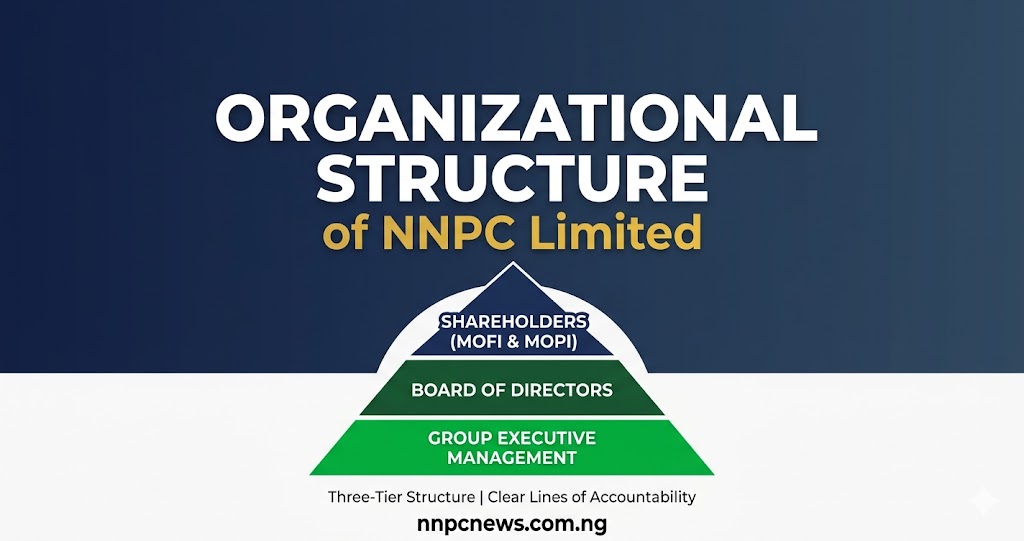
After the PIA, NNPC Limited adopted a corporate structure. It has a board of directors. An executive management team. Subsidiaries for different business areas. And clear lines of accountability.
Here’s how NNPC Limited is organized, who reports to whom, and how decisions get made.
The Short Answer
NNPC Limited has a three-tier organizational structure:
- Board of Directors — provides strategic oversight
- Group Executive Management — handles day-to-day operations
- Subsidiaries and Business Units — execute specific functions
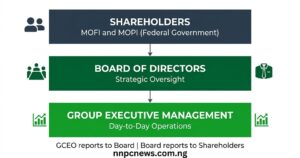
The Group Chief Executive Officer leads the management team and reports to the board. The board reports to the shareholders (MOFI and MOPI). The shareholders are the federal government.
If you’re curious about who owns NNPC Limited, the shareholders are at the top. And if you want to understand what NNPC Limited is under the Petroleum Industry Act, the corporate structure is part of the answer.
The Three-Tier Structure
Tier 1: Shareholders
At the very top are the shareholders. NNPC Limited has two shareholders:
- Ministry of Finance Incorporated (MOFI) — holds one share
- Ministry of Petroleum Incorporated (MOPI) — holds one share
Both hold these shares on behalf of the federation. The federal government is the ultimate beneficial owner.
Shareholders have specific rights under the Companies and Allied Matters Act: appointing directors, approving financial statements, declaring dividends, and approving major constitutional changes.
The NNPC ownership structure under Nigerian law places the shareholders at the apex.
Tier 2: Board of Directors
The board of directors provides strategic oversight. It is appointed by the shareholders (the President, on their behalf).
Sections 58 and 59 of the PIA establish the board structure. The board includes:
- A Non-Executive Chairman
- A Group Chief Executive Officer
- A Chief Financial Officer
- A representative each from the Ministry of Petroleum and Ministry of Finance
- Six non-executive members, one from each geo-political zone
The board is responsible for strategic direction, approving budgets, overseeing risk management, and ensuring accountability.
The NNPC board of directors and their roles are defined by the PIA.
Tier 3: Group Executive Management
The Group Executive Management team handles day-to-day operations. It is led by the Group Chief Executive Officer.
The GCEO is appointed by the board. The GCEO then leads the management team, which includes executive vice presidents for different functions.
Management implements board decisions, runs operations, and reports performance back to the board.
If you’re tracking leadership, knowing who is the GCEO of NNPC is essential for understanding who runs the company.
The Board of Directors
Composition
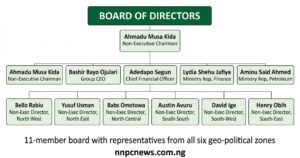
The board of NNPC Limited has 11 members as of the April 2025 leadership overhaul:
- Ahmadu Musa Kida — Non-Executive Chairman
- Bashir Bayo Ojulari — Group Chief Executive Officer
- Adedapo Segun — Chief Financial Officer
- Lydia Shehu Jafiya — Ministry of Finance representative
- Aminu Said Ahmed — Ministry of Petroleum representative
- Bello Rabiu — Non-Executive Director (North West)
- Yusuf Usman — Non-Executive Director (North East)
- Babs Omotowa — Non-Executive Director (North Central)
- Austin Avuru — Non-Executive Director (South-South)
- David Ige — Non-Executive Director (South-West)
- Henry Obih — Non-Executive Director (South-East)
Responsibilities
Under Section 63 of the PIA, the board has specific responsibilities:
- Strategic guidance on business structure
- Approval of annual budget
- Due care and good faith in all actions
- Highest ethical standards
- Corporate strategy and business risk analysis
- Ensuring integrity of accounting systems
- Communication
- Determining dividend policy
Board Committees
The board has created committees to handle specific areas. These typically include:
- Audit Committee — oversees financial reporting and internal controls
- Finance and Investment Committee — reviews major financial decisions
- Governance and Remuneration Committee — handles board appointments and compensation
- Technical Committee — oversees operational performance
The PIA requires the board to create committees within three months of incorporation.
The Group Executive Management Team
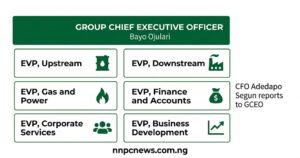
Group Chief Executive Officer
The GCEO is the head of management. The current GCEO is Bayo Ojulari, appointed in April 2025.
The GCEO is responsible for:
- Implementing board decisions
- Leading the management team
- Day-to-day operations of the company
- Representing NNPC Limited to external stakeholders
- Reporting performance to the board
The GCEO reports to the board, not to the minister. This is a fundamental change from the old NNPC.
Executive Vice Presidents
The GCEO is supported by Executive Vice Presidents who head major directorates:
- EVP, Upstream — oversees exploration and production activities
- EVP, Downstream — oversees refining, marketing, and distribution
- EVP, Gas and Power — oversees gas development and power projects
- EVP, Finance and Accounts — oversees financial management
- EVP, Corporate Services — oversees HR, legal, and administration
- EVP, Business Development — oversees growth and investment
Chief Financial Officer
The CFO manages the company’s financial affairs. The current CFO is Adedapo Segun.
The CFO is responsible for:
- Financial planning and budgeting
- Accounting and reporting
- Tax compliance
- Treasury management
- Investor relations (when applicable)
Subsidiaries and Business Units
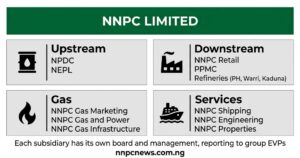
NNPC Limited operates through a group structure with multiple subsidiaries. Each subsidiary focuses on a specific segment of the petroleum value chain.
Upstream Subsidiaries
- Nigerian Petroleum Development Company (NPDC) — exploration and production
- NNPC Exploration and Production Limited (NEPL) — deepwater and frontier exploration
Downstream Subsidiaries
- NNPC Retail Limited — filling stations and retail marketing
- Petroleum Products Marketing Company (PPMC) — wholesale distribution
- Port Harcourt Refining Company — refinery operations
- Warri Refining and Petrochemical Company — refinery operations
- Kaduna Refining and Petrochemical Company — refinery operations
Gas Subsidiaries
- NNPC Gas Marketing Limited — domestic gas sales
- NNPC Gas and Power Investment Company — gas and power investments
- NNPC Gas Infrastructure Company — pipeline development
Services Subsidiaries
- NNPC Shipping Limited — marine transportation
- NNPC Engineering and Technical Company — engineering services
- NNPC Properties Limited — real estate management
The full list of NNPC subsidiaries and their functions provides more detail on each.
How the Structure Has Changed
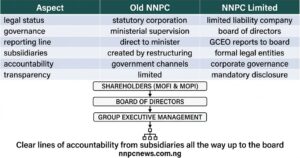
| Aspect | Old NNPC | NNPC Limited |
|---|---|---|
| Legal status | Statutory corporation | Limited liability company |
| Governance | Ministerial supervision | Board of directors |
| Reporting line | Direct to minister | GCEO reports to board |
| Subsidiaries | Created by restructuring | Formal legal entities |
| Accountability | Through government channels | Through corporate governance |
| Transparency | Limited | Mandatory disclosure |
Reporting Lines
Shareholder to Board
The shareholders (MOFI and MOPI) appoint the board. The board reports to the shareholders through annual general meetings and regular reporting.Board to Management
The board appoints the GCEO. The GCEO and management report to the board. The board reviews performance, approves budgets, and provides strategic direction.Management to Subsidiaries
Subsidiaries have their own boards and management teams. They report to NNPC Limited’s group management. The group sets policies and monitors performance.Subsidiary Reporting
Each subsidiary has its own organizational structure. They are led by Managing Directors who report to the appropriate Executive Vice President at the group level. The organizational structure of NNPC Limited creates clear lines of accountability from subsidiaries all the way up to the board.Key Takeaways
| Tier | Body | Key Responsibilities |
|---|---|---|
| 1 | Shareholders (MOFI, MOPI) | Appoint board, approve accounts, declare dividends |
| 2 | Board of Directors | Strategic oversight, approve budgets, appoint GCEO |
| 3 | Group Executive Management | Day-to-day operations, implement board decisions |
| 4 | Subsidiaries | Execute specific business functions |
The Conclusion
NNPC Limited has a three-tier organizational structure: shareholders at the top, board of directors in the middle, and group executive management at the operating level. Subsidiaries handle specific business functions. The structure is fundamentally different from the old NNPC. The old NNPC was a government agency with ministerial supervision. NNPC Limited is a company with board governance. The Group Chief Executive Officer reports to the board, not to the minister. Subsidiaries have their own boards but report to group management. Lines of accountability are clear. This structure is designed to support commercial operations, transparency, and accountability. It’s still evolving. But the foundation is in place.Official sources for verification:
Last updated: April 2026. Information based on Petroleum Industry Act 2021 provisions, NNPC announcements, and official government communications.