
If you’ve ever wondered who actually finds and produces the oil that Nigeria is famous for, the answer is not just international oil companies. NNPC has its own exploration and production arm.
NNPC Exploration and Production Limited (NEPL) is one of the key upstream subsidiaries of NNPC Limited. It focuses on deepwater and frontier exploration, managing production sharing contracts with international oil companies.
Here’s what NEPL does, how it fits into the NNPC group, and why it matters.
The Short Answer
NNPC Exploration and Production Limited (NEPL) is an upstream subsidiary of NNPC Limited. It focuses on deepwater and frontier exploration.
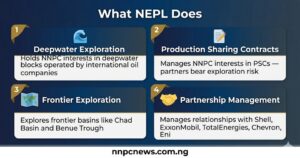
NEPL holds NNPC’s interests in deepwater blocks. It partners with international oil companies like Shell, ExxonMobil, and TotalEnergies. It also explores for oil and gas in frontier basins.
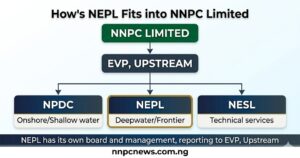
NEPL is a separate legal entity with its own board and management. It reports to the EVP, Upstream at NNPC Limited.
If you’re curious about the list of NNPC subsidiaries and their functions, NEPL is a key upstream player. And if you want to understand what NNPC Limited is under the Petroleum Industry Act, the subsidiary structure is how operations are organized.
What NEPL Does
Deepwater Exploration
NEPL focuses on deepwater exploration. Deepwater areas are offshore, in water depths that require specialized technology.
NEPL holds NNPC’s interests in deepwater blocks. These blocks are operated by international oil companies under production sharing contracts.
Production Sharing Contracts (PSCs)
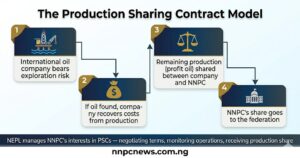
NEPL manages NNPC’s interests in production sharing contracts. Under PSCs, international oil companies bear the exploration risk.
If they find oil, they recover costs from production and share the remaining profit with NNPC (through NEPL).
This model allowed Nigeria to develop deepwater resources without bearing the full exploration cost.
Frontier Exploration
NEPL also explores for oil and gas in frontier basins. Frontier basins are areas that are not yet proven to have commercial quantities of oil and gas.
This is higher risk but potentially higher reward. Success could open new producing areas for Nigeria.
Partnership Management
NEPL manages NNPC’s relationships with international oil companies in deepwater blocks. Key partners include:
- Shell
- ExxonMobil
- TotalEnergies
- Chevron
- Eni
These partnerships combine NNPC’s ownership with partner capital and technology.
Key Deepwater Assets
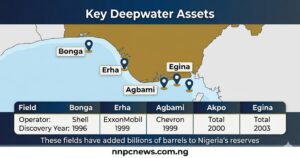
NEPL has interests in major deepwater fields. These include:
| Field | Operator | Discovery Year | NEPL Interest |
|---|---|---|---|
| Bonga | Shell | 1996 | Significant |
| Erha | ExxonMobil | 1999 | Significant |
| Agbami | Chevron | 1999 | Significant |
| Akpo | Total | 2000 | Significant |
| Egina | Total | 2003 | Significant |
These fields have added billions of barrels to Nigeria’s reserves. They are major sources of oil revenue for the federation.
The NNPC production levels explained are largely driven by these deepwater fields.
How NEPL Fits into NNPC Limited
Reporting Line
NEPL reports to the EVP, Upstream at NNPC Limited. The EVP, Upstream oversees all upstream activities, including NPDC and NEPL.
NEPL has its own board of directors and management team. The Managing Director of NEPL reports to the EVP, Upstream.
Relationship with NPDC
NEPL is different from NPDC (Nigerian Petroleum Development Company). NPDC focuses on onshore and shallow water operations. NEPL focuses on deepwater and frontier exploration.
Both are upstream subsidiaries. They have different mandates and operate in different areas.
The difference between NNPC and NNPC Limited is reflected in the subsidiary structure. Each subsidiary has a clear mandate.
Relationship with International Partners
NEPL does not operate the deepwater blocks itself. The international oil companies are the operators. NEPL is the concessionaire on behalf of the federation.
NEPL monitors operations, ensures compliance, and receives NNPC’s share of production.
The Production Sharing Contract Model
How PSCs Work
Under a production sharing contract:
- The international oil company bears exploration risk
- If oil is found, the company recovers its costs from production
- The remaining production (profit oil) is shared between the company and NNPC
- NNPC’s share goes to the federation
Why PSCs Were Needed
By the 1990s, Nigeria had explored most of its onshore and shallow water areas. The remaining potential was in deepwater — expensive, risky, technically challenging.
The joint venture model required NNPC to pay its share of costs. For deepwater, that was too expensive. The government couldn’t afford it.
PSCs solved this problem. International oil companies bore the risk. NNPC (through NEPL) got a share of production without upfront investment.
NEPL’s Role in PSCs
NEPL manages NNPC’s interests in PSCs. This includes:
- Negotiating contract terms
- Monitoring operator performance
- Ensuring compliance with regulations
- Receiving NNPC’s share of production
- Managing revenue flows
Recent Developments
Bonga Southwest Project
The $20 billion Bonga Southwest deepwater project is moving forward. This project, long delayed by regulatory and investment challenges, is now progressing.
NEPL holds NNPC’s interest in this project. The development will add significant production capacity.
Frontier Exploration
NEPL is also exploring frontier basins, including the Chad Basin and the Benue Trough. These areas are not yet proven to have commercial quantities of oil and gas.
Success could open new producing areas for Nigeria. It could also reduce dependence on the Niger Delta.
Renewed International Interest
The renewed interest from international oil companies in Nigeria’s deepwater assets suggests that global sentiment toward the country’s oil sector is improving.
NEPL is positioned to benefit from this renewed interest.
The objectives and mandate of NNPC include maximizing value from upstream operations, which NEPL helps achieve.
NEPL vs Other Upstream Subsidiaries
| Subsidiary | Focus | Operating Environment |
|---|---|---|
| NEPL | Deepwater and frontier exploration | Offshore, deepwater, frontier basins |
| NPDC | Exploration and production | Onshore, shallow water |
| NESL | Technical services | Service provider |
Each subsidiary has a distinct role. Together, they cover the full scope of upstream operations.
The organizational structure of NNPC Limited separates these functions for clarity and efficiency.
Why NEPL Matters
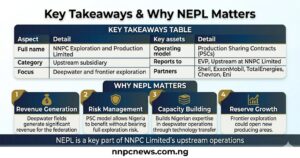
Revenue Generation
NEPL’s deepwater interests generate significant revenue for the federation. The deepwater fields are among Nigeria’s most productive.
Risk Management
By using the PSC model, NEPL allows Nigeria to benefit from deepwater resources without bearing the full exploration risk.
Capacity Building
NEPL builds Nigerian expertise in deepwater operations. It works with international partners to transfer technology and skills.
Reserve Growth
NEPL’s frontier exploration could open new producing areas. This would grow Nigeria’s reserve base and extend the life of the industry.
Key Takeaways
| Aspect | Detail |
|---|---|
| Full name | NNPC Exploration and Production Limited |
| Category | Upstream subsidiary |
| Focus | Deepwater and frontier exploration |
| Key assets | Bonga, Erha, Agbami, Akpo, Egina |
| Operating model | Production Sharing Contracts (PSCs) |
| Reports to | EVP, Upstream at NNPC Limited |
| Partners | Shell, ExxonMobil, TotalEnergies, Chevron, Eni |
The Conclusion
NNPC Exploration and Production Limited (NEPL) is an upstream subsidiary of NNPC Limited. It focuses on deepwater and frontier exploration. NEPL holds NNPC’s interests in deepwater blocks and manages production sharing contracts with international oil companies.
NEPL partners with Shell, ExxonMobil, TotalEnergies, Chevron, and Eni. It manages NNPC’s interests in major deepwater fields like Bonga, Erha, Agbami, Akpo, and Egina.
The PSC model allows Nigeria to benefit from deepwater resources without bearing the full exploration risk. NEPL is also exploring frontier basins, which could open new producing areas.
NEPL reports to the EVP, Upstream at NNPC Limited. It is a separate legal entity with its own board and management.
For Nigeria, NEPL matters because it generates significant revenue, manages risk, builds capacity, and pursues reserve growth. It is a key part of NNPC Limited’s upstream operations.
Official sources for verification:
Last updated: April 2026. Information based on Petroleum Industry Act 2021 provisions, NNPC announcements, and official government communications.