
If you’ve been following Nigerian news, you’ve probably heard about NNPC Limited. But here’s the thing — most people still don’t really understand what changed.
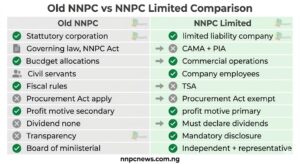
For over forty years, NNPC was a government department. Civil service rules, budgetary allocations from the National Assembly, ministers giving direct orders. That was the old NNPC.
Then 2021 happened. The Petroleum Industry Act came along and flipped the entire model. The old corporation was dissolved. A new one took its place — NNPC Limited. Same initials. Completely different animal.
What NNPC Limited Actually Means
NNPC Limited is a limited liability company registered under the Companies and Allied Matters Act of Nigeria. It’s the successor to the former Nigerian National Petroleum Corporation, which was established in 1977.
The “Limited” part matters. It means this is now a commercial entity with shareholders, a board of directors, and a legal obligation to make profit. Not a government agency. A company.
Section 53 of the PIA mandated the Minister of Petroleum Resources to incorporate this new company within six months of the Act’s commencement. They moved fast — within six weeks, NNPC Limited was registered with the Corporate Affairs Commission. Understanding when NNPC was established gives you context for why this change was so significant.
The Legal Foundation
Section 53 of the PIA
This is where it all starts. Section 53(1) of the Petroleum Industry Act 2021 requires the Minister of Petroleum Resources to cause the incorporation of NNPC Limited in consultation with the Minister of Finance.
The shares are held by two entities:
- Ministry of Finance Incorporated — one share
- Ministry of Petroleum Incorporated — one share
Both hold those shares on behalf of the federal government. So the government still owns it completely. But the legal structure is fundamentally different. The NNPC ownership structure under Nigerian law is now clearly defined in a way it never was before.
What the PIA Says About Ownership
Section 53(5) of the Act has an important restriction — the shares held by government cannot be transferred or mortgaged unless approved by the government and the National Economic Council. This protects against any backdoor privatization without proper oversight.
The initial capitalization of NNPC Limited must be enough to cover its financial requirements and handle all obligations and liabilities transferred from the old NNPC. They didn’t set it up to fail.
How NNPC Limited Was Created
Timeline
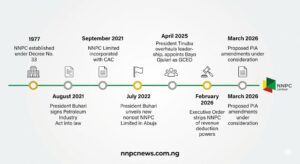
- August 2021 President Buhari signs Petroleum Industry Act into law
- September 2021 NNPC Limited incorporated with CAC
- July 2022 President Buhari unveils new NNPC Limited in Abuja
- April 2025 President Tinubu overhauls leadership, appoints Bayo Ojulari as GCEO
- Ongoing Transition and operational reforms continue
Transfer of Assets and Liabilities
Section 54 of the PIA deals with this. All assets and liabilities of the former NNPC are to be transferred to NNPC Limited. The Minister of Petroleum and Minister of Finance were given 18 months to determine exactly what gets transferred.
Here’s the kicker — if they don’t complete the determination and transfer within those 18 months, everything is deemed automatically transferred. The law doesn’t allow bureaucracy to block the transition.
Assets not transferred remain with NNPC until extinguished or moved to government. After transfers complete, the old NNPC ceases to exist. In early 2022, the House of Representatives set up an ad-hoc committee to ascertain the total inventory, assets, interests and liabilities of NNPC before transfer to NNPC Limited.
What Happened to Employees
Section 57 transferred all employees of NNPC and its subsidiaries to NNPC Limited. They keep the same or similar conditions of service they had before. They’re now employees of the new company.
The Objectives of NNPC Limited
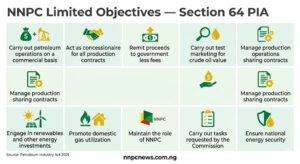
Section 64 of the PIA lists what NNPC Limited is supposed to do:
- Carry out petroleum operations on a commercial basis Profit matters.
- Act as concessionaire for all production contracts Government’s commercial representative.
- Remit proceeds to government less management fee and Frontier Exploration Fund Money flows up, but costs deducted first.
- Carry out test marketing to determine value of crude oil Know what you’re selling.
- Manage production sharing contracts Handle PSCs with international partners.
- Engage in renewables and other energy investments Not just oil anymore.
- Promote domestic gas utilization Gas matters too.
- Maintain the role of NNPC Continuity.
- Carry out tasks requested by the Commission Work with regulators.
- Engage in activities that ensure national energy security Strategic role continue.
The company is also vested as the concessionaire of all production sharing contracts, profit sharing contracts, and risk service contracts as the national oil company on behalf of the federation.
Governance Structure
The Board of Directors
Sections 58 and 59 of the PIA establish the board. Members are appointed by the President and include:
- A Non-Executive Chairman
- A Chief Executive Officer
- A Chief Financial Officer
- A representative each from the Ministry of Petroleum and Ministry of Finance (director rank or above)
- Six non-executive members with at least 15 years petroleum industry experience, one from each geo-political zone
When the company is no longer wholly government-owned, shareholders will appoint the directors instead.
2025 Leadership Changes
In April 2025, President Tinubu carried out a major overhaul of NNPC Limited’s leadership. Citing the need for “enhanced operational efficiency, restored investor confidence, and a more commercially viable NNPC,” Tinubu invoked his powers under Section 59(2) of the PIA.
The newly appointed 11-member board features:
- Ahmadu Musa Kida — Non-Executive Chairman
- Bashir Bayo Ojulari — Group Chief Executive Officer
- Adedapo Segun — Chief Financial Officer (retained)
Non-executive directors representing the six geopolitical zones:
- Bello Rabiu — North West
- Yusuf Usman — North East
- Babs Omotowa (former MD of NLNG) — North Central
- Austin Avuru — South South
- David Ige — South West
- Henry Obih — South East
Additionally, Lydia Shehu Jafiya (Permanent Secretary, Federal Ministry of Finance) and Aminu Said Ahmed (Ministry of Petroleum Resources) represent their ministries on the board.
If you’re tracking leadership, who is the GCEO of NNPC is definitely worth knowing.
Board Committees
Section 60 requires the board to create committees within three months of incorporation. The process for creating committees and nominating members must be formal and transparent. The goal is to assure the highest corporate governance standards.
Responsibilities of the Board
Section 63 lists specific duties beyond what CAMA requires:
- Strategic guidance on business structure
- Approval of annual budget
- Due care and good faith in all actions
- Highest ethical standards
- Corporate strategy and business risk analysis
- Ensuring integrity of accounting systems
- Communication
- Determining dividend policy
Corporate Governance Requirements
Standards and Practices
Section 61 requires board members to discharge responsibilities in accordance with the highest standards, practices, and principles of corporate governance.
Annual Audit
Section 62 mandates that annual audit be conducted by an independent, competent, experienced, and qualified auditor.
What Doesn’t Apply
Here’s important — the Fiscal Responsibility Act, the Public Procurement Act, and the Treasury Single Account do not apply to NNPC Limited’s operations. That’s a massive change from the old NNPC. They can operate like a real company.
Recent Financial Performance
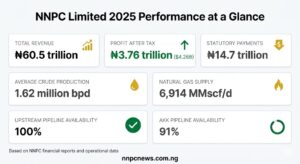
In 2025, NNPC Limited recorded strong operational and financial performance:
Metric Value;
- Total Revenue ₦60.5 trillion
- Profit After Tax ₦3.76 trillion (approx $4.26 billion)
- Statutory Payments ₦14.7 trillion
- Average Crude Production 1.62 million barrels per day (2025 average)
- December Production 1.54 million bpd (due to maintenance)
- Natural Gas Supply 6,914 million standard cubic feet per day (December)
- Operational reliability improved considerably with upstream pipeline availability at 100 percent and the AKK pipeline at 91 percent.
The detailed NNPC financial statements explained show exactly where these numbers come from.
The Incorporated Joint Venture Company Model
Section 65 and other provisions introduce the Incorporated Joint Venture Company (IJVC) model. NNPC Limited and parties to joint operating agreements can voluntarily restructure their agreements as joint ventures carried out by way of limited liability companies.
These IJVCs are independent entities with strong commercial orientation and transparent operations. This replaces the old joint venture model that was often criticized for opacity and inefficiency.
Recent Policy Shifts and Proposed Amendments
February 2026 Executive Order
President Tinubu signed an Executive Order stripping NNPC of powers to deduct revenue before remitting to the Federation Account. The 30 percent management fee on profit oil from production sharing contracts is gone. The 30 percent of profit oil earmarked for frontier exploration now goes directly to the federation. Gas flare penalties that used to flow into infrastructure funds also go to the federation now.
Proposed PIA Amendments
In late 2025, the government began proposing significant amendments to the PIA. The most consequential change would see the Nigerian Upstream Petroleum Regulatory Commission (NUPRC) replace NNPC Ltd as the government’s concessionaire in existing production-, profit- and risk-service contracts.
The amendment would vest all NNPC shares in the Federation, but they would be held solely by the Ministry of Finance Incorporated (MOFI) as the “bare agent”, displacing the Ministry of Petroleum Incorporated (MOPI) as co-owner envisaged under the 2021 Act.
This proposal has generated significant debate. Critics argue it could create a dangerous conflict of interest, with the regulator becoming both umpire and player. Energy lawyer Ayodele Oni notes, “The regulator would now be issuing licences to itself, sanctioning itself, and policing contracts in which it is financially interested”.
The proposal remains under consideration, and knowing who regulates NNPC becomes even more relevant if these changes go through.
Key Differences From the Old NNPC
Understanding the difference between NNPC and NNPC Limited isn’t just semantics — it changes how the whole organization works.
What This Means Going Forward
NNPC Limited is positioned to lead Africa’s gradual transition to new energy by deepening natural gas production and creating low carbon activities. The government is targeting an increase in crude oil production to two million barrels per day by 2027 and three million by 2030. Gas production is expected to rise to eight billion cubic feet per day by 2027 and 10 billion by 2030.
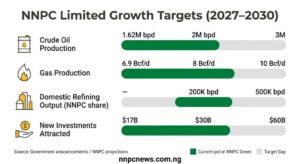
The government has also tasked the new board with raising NNPC’s share of domestic crude oil refining output to 200,000 barrels per day by 2027 and 500,000 barrels per day by 2030.
Since 2023, the administration has attracted $17 billion in new investments and is now targeting $30 billion by 2027 and $60 billion by 2030.
The reform which has started holds a lot of promises — if well implemented, it could position NNPC Limited to rival the best national oil companies globally. The swiftness shown so far in implementation is encouraging. The hope is that politics or other factors won’t truncate or hinder things.
Official sources for verification:
- • Petroleum Industry Act 2021 on the FAO Legal Database
- • Nigerian Upstream Petroleum Regulatory Commission (NUPRC)
Last updated: March 2026. Information based on Petroleum Industry Act 2021 provisions, NNPC financial reports, and official announcements.