
If you’ve ever pulled into a filling station in Nigeria and asked for fuel, you’ve dealt with NNPC. You just didn’t know it.
The Nigerian National Petroleum Company is the entity behind most of the petrol in that pump. It’s also behind the natural gas that powers industries, the crude oil the government sells to other countries, and a whole lot of arguments about where the money actually goes.
Here’s what it actually is, what it does, and why it matters beyond the headlines.
What NNPC Actually Means
NNPC stands for Nigerian National Petroleum Company. But that name only tells you half the story.
It started in 1977 when the government decided it needed a single organization to handle everything oil-related. Before that, you had different bodies doing different things — one exploring, another regulating, another handling sales. They merged them all into one corporation. Understanding difference between NNPC and NNPC Limited isn’t just semantics — it changes how the whole organization works.
Today, when someone says NNPC, they usually mean NNPC Limited. A registered company under Nigerian law. With shareholders. Required to publish audited accounts. Meant to make profit.
The Role NNPC Plays
You can’t understand NNPC without understanding that it plays multiple roles at once. Sometimes those roles pull in different directions.
The Commercial Player
First, it’s a business. NNPC explores for oil through its subsidiary, the Nigerian Petroleum Development Company. It enters joint ventures with companies like Shell and ExxonMobil. It sells crude oil to buyers overseas. It operates refineries — well, it owns them, anyway.
The commercial side is supposed to generate revenue. In 2025, NNPC reported an after-tax profit of ₦5.76 trillion, about $4.26 billion. Total revenue hit ₦60.5 trillion. Those aren’t small numbers. Looking at who regulates NNPC helps you understand who watches the watcher now.
The Supplier of Last Resort
Here’s where it gets complicated.
When private companies can’t or won’t import fuel, NNPC steps in. When refineries aren’t producing, NNPC imports. When there’s scarcity and queues form at stations, NNPC is expected to fix it.
This isn’t commercial logic. It’s political necessity. No government survives prolonged fuel scarcity. So NNPC ends up subsidizing prices, absorbing losses, and keeping the system running even when it doesn’t make financial sense. The ongoing challenges facing NNPC Limited are mostly rooted in this tension.
The Gas Developer
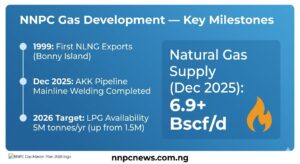
Gas is increasingly the focus. NNPC holds a 49 percent stake in Nigeria LNG Limited, the Bonny Island operation that exports liquefied natural gas to Europe and Asia. It’s pushing the Ajaokuta–Kaduna–Kano pipeline project — mainline welding was completed in December 2025. The NNPC Gas Master Plan 2026 aims to scale LPG availability from 1.5 million to 5 million tonnes annually.
The Core Functions
Break it down further and you get specific things NNPC actually does day-to-day.
Exploration and Production
NPDC, the exploration subsidiary, finds and produces oil. It operates both on its own and through joint ventures. The numbers for 2025 showed average crude production of 1.62 million barrels per day, including condensates.
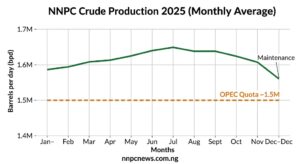
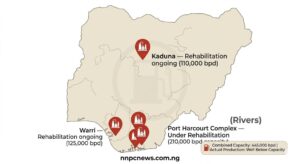
December dipped to 1.54 million because of maintenance, but that’s still significant volume. If you’re curious about NNPC refineries locations and status gives you a clearer picture of why we still import fuel.
Product Distribution
The Pipelines and Products Marketing Company, an NNPC subsidiary, handles moving fuel around the country. Pipelines, depots, trucks — the whole logistics chain. In December 2025, pipeline systems recorded 100 percent availability, which is notable. Product availability at retail stations hit 65 percent for petrol.
Gas Commercialization
This is where growth is happening. Natural gas supply averaged over 6.9 billion standard cubic feet daily in December 2025. The NLNG plant keeps exporting. Domestic gas supply obligations mean NNPC has to feed gas to power plants and industries, even when selling internationally would make more money. The NNPC LNG investments explained section covers how these projects are structured.
International Trading
NNPC Trading Limited and Duke Oil Incorporated handle crude sales and product imports. They find buyers for Nigeria’s crude, negotiate contracts, and try to get best value. When the country needs to import petrol because refineries aren’t producing, these entities source it.
How NNPC Make Money
The money comes from several places.
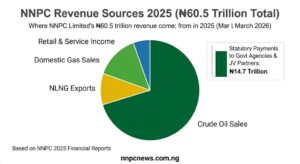
Crude oil sales are the biggest. NNPC lifts crude on behalf of the federation and sells it. The revenue is supposed to go into the Federation Account, but there’s always debate about how much actually gets there and how much is deducted first.
Domestic gas sales generate revenue. NLNG exports generate dollars. Retail outlets generate smaller but steady income. Service subsidiaries charge fees.
In 2025, total revenue hit ₦60.5 trillion. Statutory payments to government agencies and joint venture partners amounted to ₦14.7 trillion. That’s money that flowed out to others. The rest funded operations and, presumably, generated the reported profit. The detailedNNPC financial statements explainedshow exactly where these numbers come from.
The Recent Changes You Should Know
February 2026 brought a significant shift.
President Tinubu signed an Executive Order stripping NNPC of powers to deduct revenue before remitting to the Federation Account. The 30 percent management fee on profit oil from production sharing contracts? Gone. The 30 percent of profit oil earmarked for frontier exploration? Now goes directly to the federation.
Gas flare penalties that used to flow into infrastructure funds? Those also go to the federation now.
This matters because it changes how money moves. Previously, NNPC could deduct various fees and charges before passing revenue up. Now, royalties and taxes must be paid directly to fiscal authorities by contractors. The NUPRC becomes the primary interface for integrated operations.
The government’s stated reason: “over two-thirds of potential remittances were being diverted through various deductions and charges”. That’s a striking admission.
For NNPC, it means being pushed further toward pure commercial operations. Less middleman role. More focus on actual business. The question of why NNPC is important to Nigeria in the simplest terms.
Where NNPC Sits Now
The company is headquartered at NNPC Towers in Abuja’s Central Business District. Mele Kyari was Group CEO through the transition. Bashir Bayo Ojulari appeared as GCEO at the Nigeria International Energy Summit in February 2026. Leadership changes happen, but the institution continues. If you’re tracking leadership, who is the GCEO of NNPC is worth knowing.
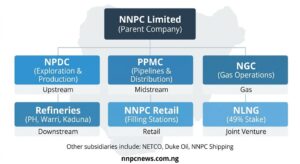
NNPC Limited Corporate Structure
The subsidiaries still operate: NPDC upstream, PPMC for pipelines, NGC for gas, NETCO for engineering, the refineries as separate entities, NLNG as a major joint venture. About 5,000 to 10,000 employees, depending on whose count you use. The full list of NNPC subsidiaries and their functions gives you the complete picture.
The difference now is legal structure. It’s a company. Required to publish accounts. Supposed to pay taxes. Meant to operate commercially.
Whether it actually operates commercially, given the political pressures and social obligations, is a question that won’t be answered by legislation alone.
Official sources for verification:
- Petroleum Industry Act 2021 on the FAO Legal Database
- Nigerian Upstream Petroleum Regulatory Commission (NUPRC)
Last updated: March 2026. Figures based on NNPC financial reports and official NUPRC announcements.