
If you’ve ever wondered who decides what NNPC Limited does, you’re not alone. The old NNPC was opaque. Decisions came from the minister, or maybe from the GMD, or maybe from somewhere else. It was hard to tell.
After the Petroleum Industry Act, the decision-making structure became clear. NNPC Limited has a governance framework that defines who decides what.
Here’s how decisions are made at NNPC Limited — from the boardroom to the front line.
The Short Answer
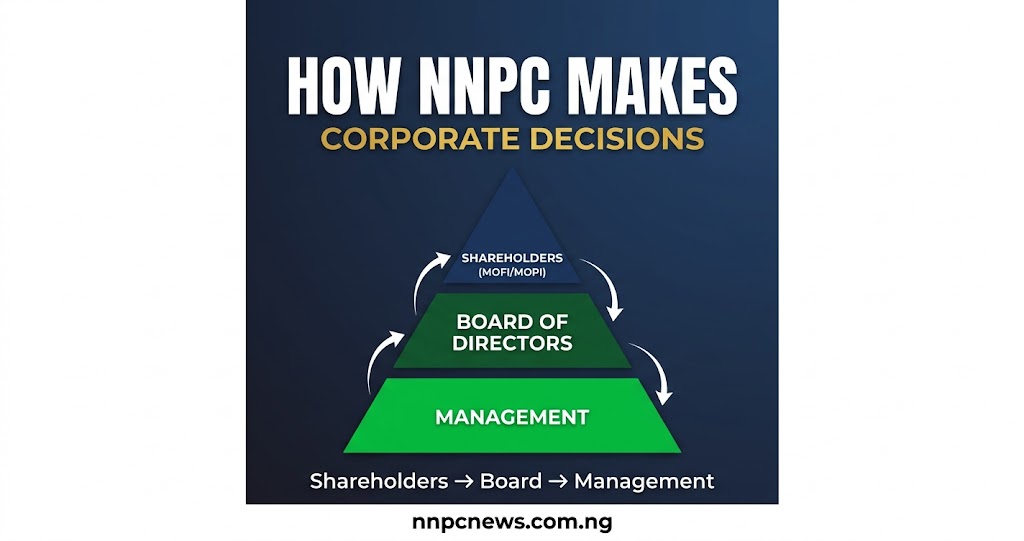
NNPC Limited makes corporate decisions through a structured governance framework. The framework has three levels:
- Shareholders — make fundamental decisions (appointing directors, approving accounts, declaring dividends)
- Board of Directors — makes strategic decisions (approving budgets, major investments, corporate strategy)
- Management — makes operational decisions (day-to-day operations, procurement, routine business)
The GCEO leads management. The board oversees management. Shareholders oversee the board.
If you’re curious about who owns NNPC Limited, shareholders are at the top. And if you want to understand what NNPC Limited is under the Petroleum Industry Act, the decision-making framework is part of the corporate governance structure.
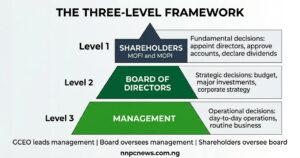
The Three-Level Decision Framework
Level 1: Shareholder Decisions
At the very top are the shareholders. NNPC Limited has two shareholders: MOFI and MOPI. Both hold shares on behalf of the federation.
Shareholder decisions are the most fundamental. They include:
- Appointing and removing directors
- Approving annual financial statements
- Declaring dividends
- Amending the memorandum and articles of association
- Changing the share capital
- Approving major transactions (in some cases)
Shareholder decisions are made at general meetings. MOFI and MOPI designate representatives to attend and vote.
The NNPC ownership structure under Nigerian law places these powers with the shareholders.
Level 2: Board Decisions
The board of directors makes strategic decisions. The board is appointed by the shareholders.
Board decisions include:
- Approving the annual budget
- Setting corporate strategy
- Approving major capital investments
- Appointing the GCEO and other senior executives
- Overseeing risk management
- Ensuring integrity of accounting systems
- Determining dividend policy (for recommendation to shareholders)
Board decisions are made at board meetings. The board meets regularly, typically quarterly.
The NNPC board of directors and their roles are defined by the PIA.
Level 3: Management Decisions
The management team makes operational decisions. The GCEO leads the management team.
Management decisions include:
- Day-to-day operations
- Procurement and contracting
- Staff hiring and management
- Routine business transactions
- Implementation of board-approved strategies
Management has delegated authority from the board. The board sets limits. Within those limits, management can act without further approval.
The functions of NNPC management team cover these operational decisions.
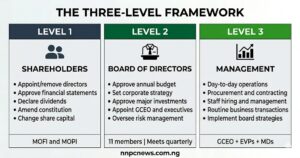
Shareholder Decisions in Detail
What Requires Shareholder Approval
Under the Companies and Allied Matters Act, certain decisions require shareholder approval:
| Decision | Description |
|---|---|
| Appointment of directors | Shareholders elect the board |
| Removal of directors | Shareholders can remove directors |
| Approval of financial statements | Shareholders must approve annual accounts |
| Declaration of dividends | Shareholders decide on dividend distribution |
| Amendment of articles | Changes to governing documents require approval |
| Change of share capital | Issuing new shares or reducing capital |
How Shareholder Decisions Are Made
Shareholder decisions are made at general meetings:
- Annual General Meetings (AGMs) — held once per year. Shareholders receive financial statements and vote on resolutions.
- Extraordinary General Meetings (EGMs) — called when specific decisions are needed between AGMs.
MOFI and MOPI each have one share, giving them equal voting power. They designate representatives to attend and vote.
The Restriction on Share Transfers
Section 53(5) of the PIA adds an important restriction. The shares cannot be transferred or mortgaged unless approved by the government and the National Economic Council.
This means the government cannot sell NNPC shares without proper oversight. No backdoor privatization.
The difference between NNPC and NNPC Limited includes this formal shareholder structure.
Board Decisions in Detail
What Requires Board Approval
The board approves significant decisions. These include:
| Decision | Description |
|---|---|
| Annual budget | Board approves budget for the coming year |
| Corporate strategy | Board sets strategic direction |
| Major capital investments | Investments above delegated authority limits |
| Senior executive appointments | GCEO and other key roles |
| Risk management framework | Board approves risk policies |
| Dividend recommendation | Board recommends to shareholders |
How Board Decisions Are Made
Board decisions are made at board meetings:
- Regular meetings are scheduled quarterly
- Special meetings can be called when needed
- Decisions are made by majority vote
- The Chairman leads the meeting
- Minutes are recorded and maintained
The board has committees that handle specific areas:
- Audit Committee — oversees financial reporting
- Finance and Investment Committee — reviews major investments
- Governance Committee — handles board appointments
- Technical Committee — oversees operations
The organizational structure of NNPC Limited includes these committees.
Management Decisions in Detail
Delegated Authority
The board delegates authority to management. The GCEO has authority for operational decisions within approved budgets and plans.
The delegation of authority framework specifies:
- Financial limits (how much management can spend without board approval)
- Contracting limits (size of contracts management can sign)
- Hiring limits (what positions management can fill)
Management Committee
The GCEO leads a management committee comprising executive leaders. This committee coordinates decisions across the company.
Management committee decisions include:
- Operational priorities
- Resource allocation
- Performance management
- Implementation of board strategies
Routine Decisions
Individual managers make routine decisions within their areas:
- Procurement decisions within delegated limits
- Staff management decisions
- Operational adjustments
- Customer and supplier interactions
The how NNPC makes corporate decisions framework ensures that decisions are made at the right level.
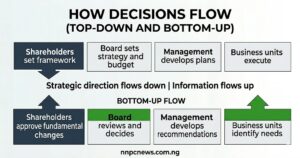
How Decisions Flow
Top-Down Flow
Strategic direction flows from top to bottom:
- Shareholders set the overall framework (through the company’s constitution)
- Board sets strategy and approves budgets
- Management develops implementation plans
- Business units execute
Bottom-Up Flow
Information and recommendations flow from bottom to top:
- Business units identify needs and opportunities
- Management develops recommendations
- Board reviews and decides on significant matters
- Shareholders approve fundamental changes
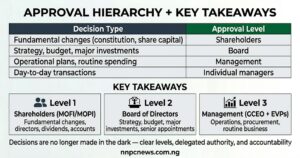
Approval Hierarchy
| Decision Type | Approval Level |
|---|---|
| Fundamental changes (constitution, share capital) | Shareholders |
| Strategy, budget, major investments | Board |
| Operational plans, routine spending | Management |
| Day-to-day transactions | Individual managers |
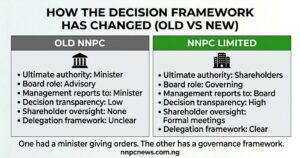
How the Decision Framework Has Changed
| Aspect | Old NNPC | NNPC Limited |
|---|---|---|
| Ultimate authority | Minister of Petroleum Resources | Shareholders (MOFI/MOPI) |
| Board role | Advisory | Governing |
| Management reporting | Reports to minister | Reports to board |
| Decision transparency | Low | High (board minutes, approvals) |
| Shareholder oversight | None | Formal shareholder meetings |
| Delegation framework | Unclear | Clear delegated authority |
The difference between NNPC and NNPC Limited is stark in decision-making. One had a minister giving orders. The other has a governance framework.
Examples of Major Decisions
Who Decides on the Annual Budget?
The management team prepares the budget. The board reviews and approves it. Shareholders are informed (but don’t typically approve operational budgets).
Who Decides on a Major Investment (e.g., $1 billion project)?
Management develops the proposal. The board reviews and approves (if within its authority). For very large investments, shareholders might need to approve if it requires constitutional changes.
Who Decides to Appoint a New GCEO?
The board appoints the GCEO. The board is appointed by shareholders.
Who Decides to Declare Dividends?
The board recommends dividends. Shareholders approve and declare.
Who Decides on Day-to-Day Procurement?
Management within delegated authority limits. Larger contracts require board approval.
The objectives and mandate of NNPC guide all these decisions.
Transparency and Accountability
Board Minutes
Board decisions are recorded in minutes. Minutes are available to shareholders. Some information may be disclosed publicly.
Financial Reporting
The management team prepares financial statements. The board approves them. Shareholders approve at AGMs. The statements are published publicly.
The NNPC financial statements explained show the results of these decisions.
Shareholder Oversight
Shareholders (MOFI and MOPI) oversee the board through:
- AGMs and EGMs
- Approval of financial statements
- Appointment and removal of directors
Public Accountability
The PIA requires transparency. NNPC Limited must publish audited financial statements. Nigerians can see the results of major decisions.
Key Takeaways
| Level | Who | What They Decide |
|---|---|---|
| 1 | Shareholders (MOFI/MOPI) | Fundamental changes, directors, dividends, accounts |
| 2 | Board of Directors | Strategy, budget, major investments, senior appointments |
| 3 | Management (GCEO + EVPs) | Operations, procurement, routine business |
The Conclusion
NNPC Limited makes corporate decisions through a structured governance framework. The framework has three levels: shareholders, board of directors, and management.
Shareholders make fundamental decisions: appointing directors, approving accounts, declaring dividends. The board makes strategic decisions: approving budgets, major investments, corporate strategy. Management makes operational decisions: day-to-day operations, procurement, routine business.
The framework is fundamentally different from the old NNPC. The old NNPC had a minister giving orders. NNPC Limited has a governance framework with clear levels, delegated authority, and accountability.
For Nigerians, this means greater transparency. The PIA requires audited financial statements. Board minutes are recorded. Shareholders have oversight. The lines of decision-making are clear.
The system is still evolving. But the foundation is in place. Decisions are no longer made in the dark.
Official sources for verification:
Last updated: April 2026. Information based on Petroleum Industry Act 2021 provisions, Companies and Allied Matters Act, and official government communications.