
If you want to understand who really runs NNPC Limited, you need to understand the board. Not the minister. Not the GCEO alone. The board.
Before the Petroleum Industry Act, the old NNPC had a board that served mostly in an advisory capacity. Real power sat with the minister. The board was there for show.
After the PIA, everything changed. NNPC Limited has a proper board of directors. It has real power. It provides strategic oversight. It appoints the GCEO. It approves budgets. It holds management accountable.
Here’s who sits on the board, what they do, and how the board has evolved.
The Short Answer
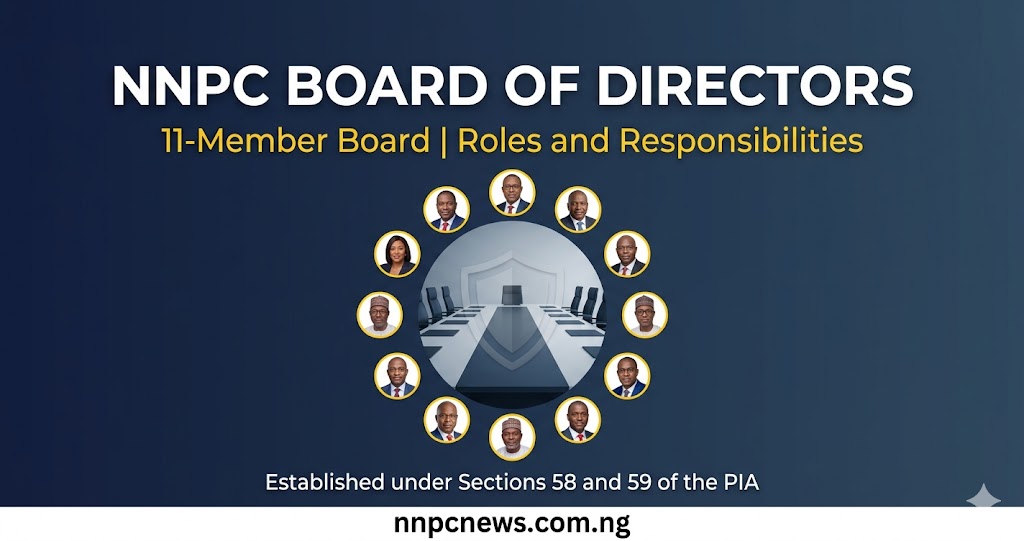
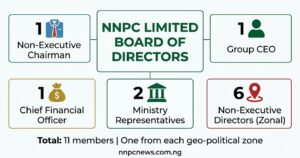
NNPC Limited has an 11-member board of directors. The board is responsible for strategic oversight, approving budgets, appointing the Group Chief Executive Officer, and ensuring accountability.
The board includes:
- A Non-Executive Chairman
- A Group Chief Executive Officer
- A Chief Financial Officer
- Two ministry representatives (Finance and Petroleum)
- Six non-executive directors, one from each geo-political zone
The board was overhauled in April 2025. The current board is led by Chairman Ahmadu Musa Kida. The GCEO is Bayo Ojulari.
- If you’re curious about who is the GCEO of NNPC, that’s one role on the board. And if you want to understand what NNPC Limited is under the Petroleum Industry Act, the board structure is a key part of the governance framework.
The Legal Framework
Sections 58 and 59 of the PIA
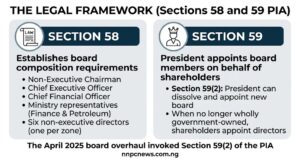
The Petroleum Industry Act establishes the board of directors for NNPC Limited. Sections 58 and 59 set out the composition, appointment process, and responsibilities.
The PIA requires the board to include:
- A Non-Executive Chairman
- A Chief Executive Officer
- A Chief Financial Officer
- A representative each from the Ministry of Petroleum and Ministry of Finance
- Six non-executive members, one from each geo-political zone
Appointment Process
The President appoints the board members on behalf of the shareholders (MOFI and MOPI). The April 2025 leadership changes demonstrated this process.
President Tinubu invoked Section 59(2) of the PIA to dissolve the old board and appoint a new one. This is the legal mechanism for board changes.
When the Company Is No Longer Wholly Government-Owned
Section 59 also contemplates a future when NNPC Limited may no longer be wholly government-owned. At that point, shareholders will appoint directors differently.
For now, the government retains full control through the appointment process.
The NNPC ownership structure under Nigerian law places the board appointment power with the government.
The Legal Framework — Sections 58 and 59 of the PIA
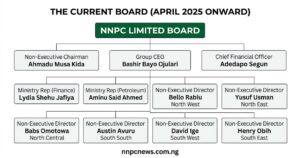
The Current Board (April 2025 Onward)
Non-Executive Chairman
Ahmadu Musa Kida serves as the Non-Executive Chairman of the board.
The Chairman leads the board, sets the agenda for meetings, and ensures that the board functions effectively. The Chairman does not participate in day-to-day management.
Kida brings extensive experience in the petroleum sector. He previously held leadership positions in the industry.
Group Chief Executive Officer
Bashir Bayo Ojulari serves as the Group Chief Executive Officer.
The GCEO is the head of management. He leads the executive team, implements board decisions, and manages day-to-day operations.
Ojulari was appointed in April 2025. He has emphasized transparency, cost efficiency, and world-class project delivery as priorities.
If you’re tracking leadership, knowing who is the GCEO of NNPC is essential for understanding the company’s direction.
Chief Financial Officer
Adedapo Segun serves as the Chief Financial Officer.
The CFO manages the company’s financial affairs. He is responsible for financial planning, accounting, tax compliance, and treasury management.
Segun was retained from the previous board, providing continuity in financial leadership.
Ministry Representatives
Lydia Shehu Jafiya represents the Ministry of Finance. She is the Permanent Secretary of the Federal Ministry of Finance.
Aminu Said Ahmed represents the Ministry of Petroleum Resources.
These representatives ensure that government policy perspectives are represented at the board level.
Non-Executive Directors (Geo-Political Zones)
The PIA requires six non-executive directors, one from each geo-political zone:
| Zone | Director |
|---|---|
| North West | Bello Rabiu |
| North East | Yusuf Usman |
| North Central | Babs Omotowa |
| South South | Austin Avuru |
| South West | David Ige |
| South East | Henry Obih |
These directors bring diverse regional perspectives and independent judgment to board deliberations.
The difference between NNPC and NNPC Limited is evident in this board structure. The old NNPC never had this level of independent, regional representation.
Roles and Responsibilities of the Board
Under Section 63 of the PIA
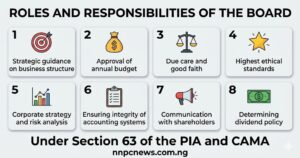
Section 63 of the PIA lists specific responsibilities of the board:
- Strategic guidance on business structure — The board sets the overall direction of the company.
- Approval of annual budget — The board reviews and approves the company’s budget each year.
- Due care and good faith in all actions — Directors must act in the best interest of the company.
- Highest ethical standards — The board sets the tone for corporate ethics.
- Corporate strategy and business risk analysis — The board oversees strategy and risk management.
- Ensuring integrity of accounting systems — The board ensures financial reporting is accurate.
- Communication — The board ensures effective communication with shareholders.
- Determining dividend policy — The board recommends dividends to shareholders.
Under the Companies and Allied Matters Act
CAMA also imposes duties on directors:
- Fiduciary duty — Directors must act in the best interest of the company.
- Duty of care — Directors must exercise reasonable care and skill.
- Duty to avoid conflicts of interest — Directors must not put personal interests ahead of the company.
Additional Board Responsibilities
Beyond the legal requirements, the board also:
- Appoints and removes the GCEO and other senior executives
- Monitors management performance
- Oversees internal controls and risk management
- Ensures compliance with laws and regulations
- Approves major transactions and investments
The objectives and mandate of NNPC guide the board’s strategic decisions.
Board Committees
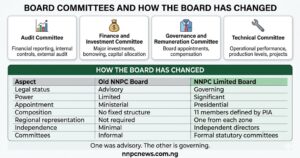
The board has created committees to handle specific areas more efficiently. These committees report to the full board.
Audit Committee
The Audit Committee oversees financial reporting, internal controls, and external audit. It ensures the integrity of the company’s financial statements.
The committee meets with internal and external auditors regularly. It reviews audit findings and ensures management takes corrective action.
Finance and Investment Committee
The Finance and Investment Committee reviews major financial decisions. This includes large investments, borrowing, and capital allocation.
The committee makes recommendations to the full board for approval.
Governance and Remuneration Committee
The Governance and Remuneration Committee handles board appointments, director compensation, and corporate governance matters.
It ensures that the board has the right composition and that directors are appropriately compensated.
Technical Committee
The Technical Committee oversees operational performance. It reviews production levels, project execution, and technical standards.
The committee ensures that the company’s operations are efficient and effective.
The PIA requires the board to create committees within three months of incorporation. These committees are now fully operational.
How the Board Has Changed
| Aspect | Old NNPC Board | NNPC Limited Board |
|---|---|---|
| Legal status | Advisory | Governing |
| Power | Limited | Significant |
| Appointment | Ministerial | Presidential |
| Composition | No fixed structure | Defined by PIA (11 members) |
| Regional representation | Not required | One from each zone |
| Independence | Minimal | Independent directors |
| Committees | Informal | Formal statutory committees |
The difference between NNPC and NNPC Limited is stark when it comes to the board. One was advisory. The other is governing.
The April 2025 Board Overhaul
What Happened
On April 2, 2025, President Tinubu dissolved the existing board of NNPC Limited and appointed new leadership.
The old board was removed. An entirely new 11-member board was appointed.
Why It Happened
The government cited the need for “enhanced operational efficiency, restored investor confidence, and a more commercially viable NNPC.”
President Tinubu invoked his powers under Section 59(2) of the PIA to make the changes.
Who Was Appointed
The new board features:
- Ahmadu Musa Kida — Non-Executive Chairman
- Bashir Bayo Ojulari — Group Chief Executive Officer
- Adedapo Segun — Chief Financial Officer (retained)
- Lydia Shehu Jafiya — Ministry of Finance representative
- Aminu Said Ahmed — Ministry of Petroleum representative
- Bello Rabiu — North West
- Yusuf Usman — North East
- Babs Omotowa — North Central
- Austin Avuru — South South
- David Ige — South West
- Henry Obih — South East
What This Means
The overhaul demonstrates that ultimate control rests with the President, who appoints directors under Section 59(2) of the PIA.
When NNPC Limited fails to perform, shareholders (the government) can demand changes. The April 2025 board overhaul was an example of this accountability in action.
How the Board Interacts with Management
The GCEO Reports to the Board
The Group Chief Executive Officer reports to the board, not to the minister. This is a fundamental change from the old NNPC.
The board sets strategy. Management implements it. The board monitors performance. Management reports results.
Board Meetings
The board meets regularly, typically quarterly. Special meetings can be called when needed.
Meetings follow formal agendas. Materials are circulated in advance. Decisions are recorded in minutes.
Board Approval Requirements
Certain decisions require board approval:
- Annual budget
- Major capital investments
- Senior executive appointments
- Dividend declarations
- Major contracts
Management has delegated authority for routine decisions. The board reserves authority for significant matters.
The organizational structure of NNPC Limited clearly separates board oversight from management execution.
Key Takeaways
| Role | Name | Responsibility |
|---|---|---|
| Chairman | Ahmadu Musa Kida | Leads board, sets agenda |
| GCEO | Bashir Bayo Ojulari | Head of management |
| CFO | Adedapo Segun | Financial management |
| Ministry Reps | Jafiya, Ahmed | Government policy perspective |
| Non-Executive Directors | Six zonal reps | Independent judgment, regional representation |
Conclusion
NNPC Limited has an 11-member board of directors established under Sections 58 and 59 of the Petroleum Industry Act. The board includes a Non-Executive Chairman, a Group Chief Executive Officer, a Chief Financial Officer, two ministry representatives, and six non-executive directors from each geo-political zone.
The board is responsible for strategic oversight, approving budgets, appointing the GCEO, and ensuring accountability. It has formal committees for audit, finance, governance, and technical matters.
The board was overhauled in April 2025. The current board is led by Chairman Ahmadu Musa Kida and GCEO Bayo Ojulari.
The board structure is fundamentally different from the old NNPC. One was advisory. The other is governing. This change is central to NNPC Limited’s transformation into a commercial company.
Official sources for verification:
Last updated: April 2026. Information based on Petroleum Industry Act 2021 provisions, NNPC announcements, and official government communications.