
If you’ve ever wondered what NNPC is actually supposed to do, you’re not alone. For decades, the answer kept shifting depending on who you asked and what the government needed that week.
But the Petroleum Industry Act 2021 changed that. It gave NNPC Limited a clear, written list of objectives. Not vague aspirations. Specific, legal requirements.
Here’s what the law says NNPC Limited must do, what it can’t do, and why the mandate matters for every Nigerian who buys fuel or cares about oil revenue.
The Short Version
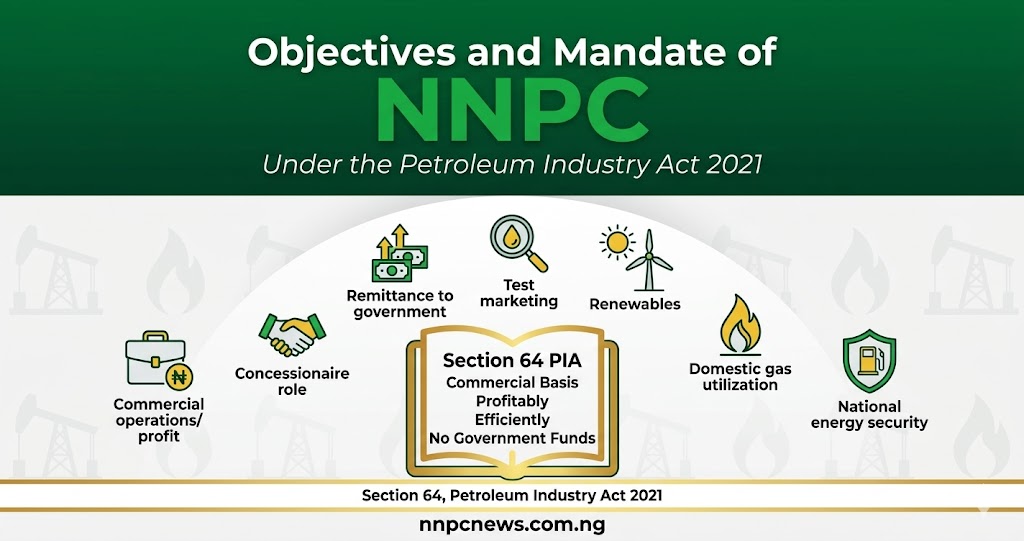
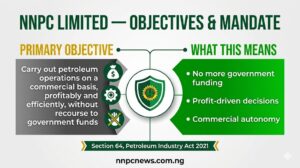
NNPC Limited has one main objective: to carry out petroleum operations on a commercial basis, profitably and efficiently, without recourse to government funds.
Beyond that, the PIA lists ten specific objectives. These range from acting as concessionaire for production contracts to engaging in renewable energy and ensuring national energy security.
If you’re trying to understand what NNPC Limited is under the Petroleum Industry Act, the objectives section of the law is where you’ll find the clearest answer.
The Primary Objective: Commercial Operations
What the Law Says
Section 64(1) of the PIA states that NNPC Limited shall “carry out petroleum operations on a commercial basis, profitably and efficiently, without recourse to government funds.”
This is the foundation. Everything else flows from this.
Three words matter most: “commercial basis,” “profitably,” and “efficiently.” The old NNPC wasn’t required to be any of these things. It was a government department. Profit wasn’t the point. Efficiency was optional.
No More Government Funding
The phrase “without recourse to government funds” is crucial. It means NNPC Limited cannot go back to the federal government with its hand out, asking for budgetary allocations.
The share capital provided at incorporation is the last direct government funding the company will receive. Everything else — salaries, investments, operations — must come from internally generated revenue or commercial borrowing.
What This Means in Practice
Running on a commercial basis means decisions are made based on profit and loss, not politics. If a project doesn’t make financial sense, NNPC Limited shouldn’t do it. If a partnership doesn’t generate returns, it should be reviewed.
This is a massive cultural shift for an organization that spent four decades operating as a government agency.
The Ten Specific Objectives
Section 64(2) of the PIA lists the specific objectives of NNPC Limited. Here they are:
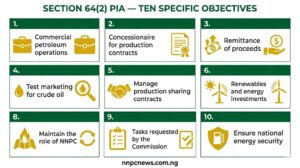
| No. | Objective | What It Means |
|---|---|---|
| 1 | Carry out petroleum operations on a commercial basis | Profit matters more than politics |
| 2 | Act as concessionaire for all production contracts | Government’s commercial representative |
| 3 | Remit proceeds to government less management fee and Frontier Exploration Fund | Money flows up, but costs deducted first |
| 4 | Carry out test marketing to determine value of crude oil | Know what you’re selling and at what price |
| 5 | Manage production sharing contracts | Handle PSCs with international partners |
| 6 | Engage in renewables and other energy investments | Not just oil anymore |
| 7 | Promote domestic gas utilization | Gas matters too |
| 8 | Maintain the role of NNPC | Continuity during transition |
| 9 | Carry out tasks requested by the Commission | Work with regulators |
| 10 | Engage in activities that ensure national energy security | Strategic role continues |
1. Commercial Petroleum Operations
This is the primary objective restated. NNPC Limited must operate like any other oil and gas company — make profit, manage costs, compete for business.
2. Concessionaire for Production Contracts
NNPC Limited acts as the government’s commercial representative in all production sharing contracts, profit sharing contracts, and risk service contracts. This means it sits on the government’s side of the table in negotiations with international oil companies.
3. Remittance of Proceeds
Money from petroleum operations flows up to the government, but NNPC Limited can deduct a management fee and contributions to the Frontier Exploration Fund before remitting. This is how the company funds its operations.
The February 2026 Executive Order changed some of these deductions, eliminating the 30 percent management fee on profit oil from production sharing contracts.
4. Test Marketing for Crude Oil
NNPC Limited must carry out test marketing to determine the true value of crude oil. This prevents the company from selling at below-market prices. Knowing how NNPC makes money starts with understanding this valuation function.
5. Management of Production Sharing Contracts
PSCs are complex agreements where international oil companies bear exploration risk in exchange for a share of production. NNPC Limited manages these contracts on behalf of the federation.
6. Renewables and Other Energy Investments
The PIA explicitly allows NNPC Limited to invest outside oil. This includes solar, wind, hydrogen, and other energy sources. The company isn’t just an oil company anymore — it’s an energy company.
7. Domestic Gas Utilization
Promoting domestic gas use is a specific objective. This means supplying gas to power plants, industries, and homes within Nigeria, even when exporting would generate more revenue.
The NNPC and domestic gas supply obligations are central to this objective.
8. Maintain the Role of NNPC
During the transition from the old NNPC to NNPC Limited, this objective ensured continuity. The new company stepped into the old one’s shoes without disruption.
9. Tasks Requested by the Commission
The Nigerian Upstream Petroleum Regulatory Commission can request NNPC Limited to perform specific tasks. This ensures coordination between the commercial entity and the regulator.
Understanding who regulates NNPC helps explain how this relationship works.
10. National Energy Security
This is the catch-all objective. NNPC Limited can engage in activities that ensure national energy security, even if they aren’t purely commercial. This includes maintaining strategic fuel reserves and ensuring supply during emergencies.
What NNPC Limited Cannot Do
The PIA also places limits on NNPC Limited’s powers.
No Price Determination
Sections 31(e) and 32(e) of the PIA place responsibility for fixing petroleum product prices with the Nigerian Midstream and Downstream Petroleum Regulatory Authority, not NNPC Limited.
The company cannot unilaterally decide what petrol costs at the pump.
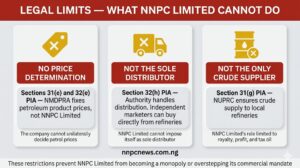
Not the Sole Distributor
Section 32(h) gives the authority responsibility for distribution of petroleum products. Independent marketers can purchase directly from refineries like Dangote on their own terms. NNPC Limited cannot impose itself as the sole distributor.
Not the Only Crude Supplier
Section 31(g) gives the NUPRC mandate to ensure crude supply to local refineries. NNPC Limited’s role is restricted to dealings in royalty oil, profit oil, and tax oil only.
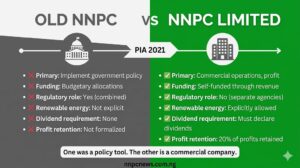
How This Differs from the Old NNPC
| Aspect | Old NNPC | NNPC Limited |
|---|---|---|
| Primary objective | Implement government policy | Commercial operations, profit |
| Funding | Budgetary allocations | Self-funded through revenue |
| Regulatory role | Yes (combined) | No (separate agencies) |
| Renewable energy | Not explicitly | Explicitly allowed |
| Dividend requirement | None | Must declare dividends |
| Profit retention | Not formalized | 20% of profits retained |
The difference between NNPC and NNPC Limited in terms of mandate is stark. One was a policy tool. The other is a commercial company.
Recent Developments Affecting the Mandate
February 2026 Executive Order
President Tinubu signed an Executive Order stripping NNPC of powers to deduct revenue before remitting to the Federation Account. The 30 percent management fee on profit oil from production sharing contracts was eliminated.
This directly affects Objective 3 (remittance of proceeds). The company now has less ability to deduct costs before money flows up.
Proposed PIA Amendments
In late 2025, the government began proposing amendments that would see the NUPRC replace NNPC Ltd as the government’s concessionaire in existing production-, profit- and risk-service contracts.
If passed, this would significantly alter Objective 2 (acting as concessionaire). The regulator would become both umpire and player — a controversial proposal.
April 2025 Leadership Changes
President Tinubu appointed Bayo Ojulari as Group Chief Executive Officer and Ahmadu Musa Kida as board chairman. The new board was tasked with implementing the commercial mandate more aggressively.
If you’re tracking leadership, knowing who is the GCEO of NNPC matters for understanding how the mandate will be executed.
The Frontier Exploration Fund Connection
One of the more complex parts of NNPC Limited’s mandate involves the Frontier Exploration Fund.
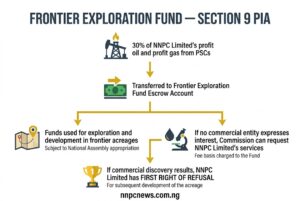
Section 9 of the PIA establishes the Frontier Exploration Fund. It shall be maintained from 30 percent of NNPC Limited’s profit oil and profit gas from production sharing, profit sharing, and risk service contracts.
NNPC Limited transfers this 30 percent to the Frontier Exploration Fund escrow account, dedicated for development of frontier acreages. The company utilizes the funds to carry out exploration and development activities in frontier areas, subject to National Assembly appropriation.
If the Commission judges that data acquired under a petroleum exploration license requires testing and drilling, and no commercial entity has expressed intention to do so, the Commission can request NNPC Limited’s services on a fee basis charged to the Frontier Exploration Fund.
Where commercial discovery results, NNPC Limited has first right of refusal in award of the acreage for subsequent development.
What This Means for Nigerians
Fuel Supply Security
The mandate to ensure national energy security means NNPC Limited must keep fuel flowing, even when it’s not profitable. This is the supplier-of-last-resort role that often puts the company in difficult financial positions.
Revenue to Government
Objectives 3 and 4 (remittance and test marketing) are designed to ensure the government gets fair value from petroleum resources. When NNPC Limited does its job well, more money flows into the federation account.
Transparency
The commercial mandate requires audited financial statements and public disclosure. The old NNPC published accounts for the first time in 40 years in 2019. NNPC Limited must do this annually.
The NNPC financial statements explained show exactly how the mandate is being executed.
Investment and Jobs
The renewables objective opens new investment opportunities. The gas utilization objective supports industrialization. When NNPC Limited fulfills its mandate, the entire economy benefits.
Key Takeaways
| Objective | Key Implication |
|---|---|
| Commercial operations | No more government funding |
| Concessionaire role | Sits on government’s side in contract negotiations |
| Remittance | Money flows up after deductions |
| Test marketing | Prevents below-market crude sales |
| PSC management | Handles complex deepwater contracts |
| Renewables | Not just an oil company anymore |
| Gas utilization | Supports domestic power and industry |
| Energy security | Supplier of last resort |
The Conclusion
NNPC Limited’s objectives and mandate are clearly defined in Section 64 of the Petroleum Industry Act 2021. The primary objective is to carry out petroleum operations on a commercial basis, profitably and efficiently, without recourse to government funds.
Ten specific objectives flesh out what this means in practice — from acting as concessionaire for production contracts to engaging in renewable energy and ensuring national energy security.
The mandate is fundamentally different from the old NNPC’s purpose. One was a government department implementing policy. The other is a commercial company required to make profit.
Whether NNPC Limited fully lives up to this mandate depends on consistent implementation, strong governance, and the willingness to put commercial logic ahead of political pressure.
Official sources for verification:
Last updated: March 2026. Information based on Petroleum Industry Act 2021 provisions, NNPC announcements, and official government communications.