
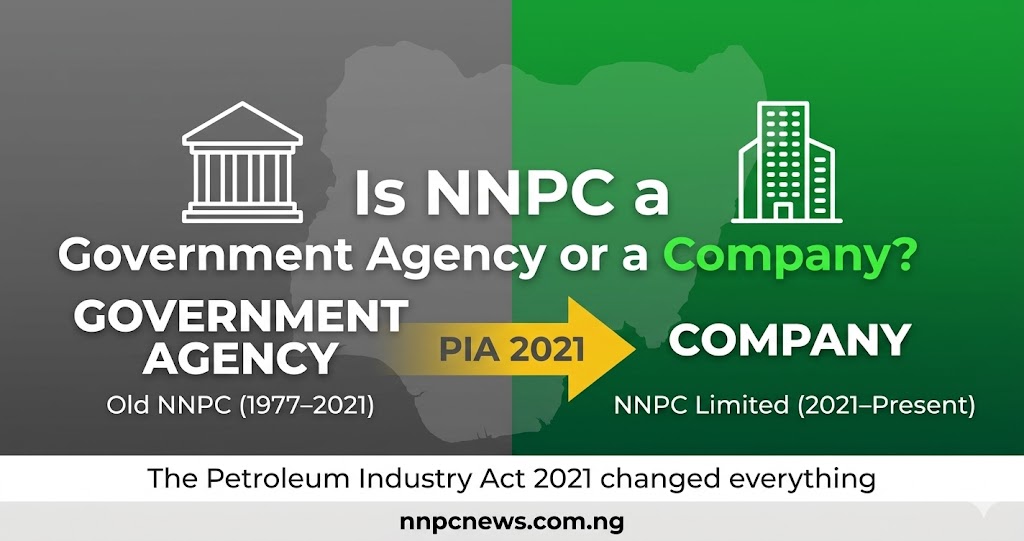
If you ask ten Nigerians this question, you might get ten different answers. Some will say “government agency” because that’s what it’s always been. Others will say “company” because they’ve heard about the Petroleum Industry Act.
Both answers have been correct at different times.
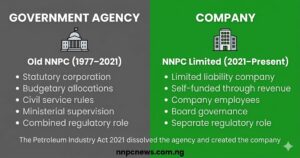
Before 2021, NNPC was a government agency. A statutory corporation funded by budgetary allocations, run by civil service rules, supervised by a minister.
After 2021, NNPC became NNPC Limited. A company registered under the Companies and Allied Matters Act. With shareholders. Required to make profit. Expected to pay taxes.
Here’s what changed, what didn’t, and why the distinction matters.
The Short Answer
NNPC Limited is a company. Not a government agency. That’s the legal answer.
The old NNPC was a government agency. It was established by Decree No. 33 of 1977 as a statutory corporation. It operated under government regulations, received budgetary allocations, and was directly supervised by the Minister of Petroleum Resources.
The Petroleum Industry Act 2021 dissolved that agency and created NNPC Limited in its place. Section 53 of the PIA mandated the incorporation of NNPC Limited under the Companies and Allied Matters Act.
If you’re trying to understand what NNPC Limited is under the Petroleum Industry Act, the legal status is the first thing to grasp.
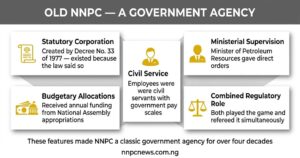
What Made the Old NNPC a Government Agency?
Statutory Corporation Status
The old NNPC was created by an act of parliament — Decree No. 33 of 1977, later codified as the NNPC Act. This made it a statutory corporation.
Statutory corporations are government entities. They exist because a law says they exist. Their powers, structure, and very existence come from that law, not from company registration.
Budgetary Allocations
As a government agency, NNPC received annual budgetary allocations from the federal government. Its operations were funded through appropriations approved by the National Assembly.
This meant NNPC didn’t need to make profit to survive. It got money regardless of performance. If it ran out, it asked for more.
Civil Service Rules
Employees of the old NNPC were civil servants. Their terms followed public service rules. Compensation was determined by government pay scales.
This made it hard to attract specialized talent. A petroleum engineer could earn much more working for an international oil company.
Ministerial Supervision
The Minister of Petroleum Resources had direct supervisory authority. Major decisions required ministerial approval. The minister could give orders, and NNPC followed them.
The board, when it existed, served mostly in an advisory capacity. Real power sat with the minister.
Combined Regulatory and Commercial Functions
The old NNPC both participated in the industry and regulated it. It was like a football player doubling as the referee.
This dual role created obvious conflicts. But it was characteristic of government agencies in strategic sectors.
If you’re trying to understand the difference between NNPC and NNPC Limited, these features of the old agency are the starting point.
What Makes NNPC Limited a Company?
Registration Under CAMA
NNPC Limited is registered with the Corporate Affairs Commission under the Companies and Allied Matters Act. This is the same law that governs Dangote Cement, MTN Nigeria, and every other company in the country.
Registration under CAMA means NNPC Limited has a memorandum and articles of association. It has a board of directors. It has shareholders. It must follow company law.
Shareholding Structure
NNPC Limited has actual shares. Two of them, to be exact:
- Ministry of Finance Incorporated (MOFI) — holds one share
- Ministry of Petroleum Incorporated (MOPI) — holds one share
Both hold these shares on behalf of the federal government. So the government still owns it completely. But ownership is now formalized through shares, not just a law saying “there shall be a corporation.”
If you’re curious about who owns NNPC Limited, the shareholding structure is the answer.
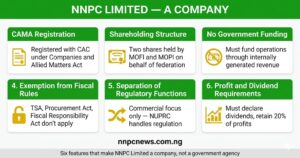
No Government Funding
NNPC Limited no longer receives budgetary allocations. It must fund its operations through internally generated revenue and commercial borrowing.
This changes everything. The company must actually make money to survive. It must manage costs. It must pursue profitable opportunities.
Exemption from Fiscal Rules
The Fiscal Responsibility Act, the Public Procurement Act, and the Treasury Single Account do not apply to NNPC Limited’s operations.
This is huge. The old NNPC was bound by government procurement rules that caused delays and inefficiencies. NNPC Limited can operate like a real company.
Separation of Regulatory Functions
The PIA separates commercial and regulatory functions. NNPC Limited focuses exclusively on commercial operations.
Regulatory functions now reside with:
- Nigerian Upstream Petroleum Regulatory Commission (NUPRC) — oversees upstream activities
- Nigerian Midstream and Downstream Petroleum Regulatory Authority — regulates midstream and downstream operations
Knowing who regulates NNPC helps explain why this separation matters.
Profit and Dividend Requirements
The PIA requires NNPC Limited to conduct its affairs on a commercial basis, profitably and efficiently, without recourse to government funds. It must declare dividends to shareholders and retain 20 percent of profits as retained earnings.
The old NNPC didn’t declare dividends. It didn’t retain earnings for growth in any formal sense.
What Hasn’t Changed?
Government Still Owns It
Despite becoming a company, NNPC Limited is still wholly owned by the federal government. The government is the sole shareholder through MOFI and MOPI.
This isn’t privatization. It’s commercialization. The government still controls the company. But control is now exercised through shareholding and board appointments, not direct ministerial supervision.
Strategic Importance
NNPC Limited remains strategically important to Nigeria’s economy. Oil and gas revenue still dominates government income. Fuel supply still affects every Nigerian.
The company’s mandate includes ensuring national energy security. That strategic role hasn’t changed, even if the legal structure has.
Some Employees Transferred
Section 57 of the PIA transferred all employees of NNPC and its subsidiaries to NNPC Limited with the same or similar conditions of service they had before.
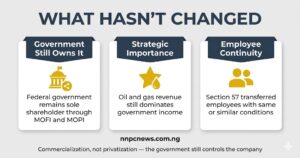
Over time, employment terms will shift toward company norms. But the transition preserved continuity.
What the Law Says
Section 53 of the PIA
This section mandated the incorporation of NNPC Limited. It required the Minister of Petroleum Resources to cause the incorporation within six months of the Act’s commencement.
The shares are held by MOFI and MOPI on behalf of the federation. Section 53(5) provides that these shares cannot be transferred or mortgaged unless approved by the government and the National Economic Council.
Section 55 of the PIA
This section specifies that NNPC Limited is not subject to the provisions of the NNPC Act or other laws applicable to government agencies.
The company operates under the Companies and Allied Matters Act like any other commercial entity.
The NNPC Act Repeal
Section 257 of the PIA explicitly abolished the Nigerian National Petroleum Corporation established under the NNPC Act. The old agency ceased to exist.
NNPC Limited is the successor. But it’s a different legal animal entirely.
What This Means in Practice
For Decision-Making
As a company, NNPC Limited’s board makes strategic decisions. The minister no longer gives direct orders. The Group Chief Executive Officer reports to the board, not to the minister.
The April 2025 leadership changes demonstrated this. President Tinubu, acting as shareholder, appointed new board members and GCEO. He didn’t issue direct operational orders.
If you’re tracking leadership, knowing who is the GCEO of NNPC matters for understanding where the company is headed.
For Funding
The company must generate its own revenue. In 2025, NNPC Limited recorded total revenue of ₦60.5 trillion and profit after tax of ₦3.76 trillion.
The detailed NNPC financial statements explained show how this new funding model is working.
For Accountability
As a company, NNPC Limited must publish audited financial statements annually. The old NNPC wasn’t required to do this. The PIA made it mandatory.
Transparency requirements are designed to ensure that the company’s beneficial owners — the Nigerian people — can see what’s happening with their oil money.
For Legal Liability
NNPC Limited can sue and be sued in its own name. It owns assets directly. It incurs liabilities independently of the government.
This separation protects the government from direct liability while enabling NNPC Limited to operate commercially.
Why This Distinction Matters
For International Partners
International oil companies prefer to partner with commercial entities, not government agencies. The transition to company status makes NNPC Limited a more attractive partner.
This matters for investment. The $20 billion Bonga Southwest deepwater project moving forward is one example of renewed confidence.
For Investors
The planned public listing of NNPC Limited depends on its company status. You can’t list a government agency on a stock exchange. You can list a company.
The move toward listing on exchanges like NYSE and LSE is only possible because NNPC Limited is now a company.
For Nigerians
The distinction affects accountability. A company with audited accounts, shareholders, and dividend requirements is held to a different standard than a government agency.
When NNPC Limited fails to perform, shareholders (the government) can demand changes. The April 2025 board overhaul was an example of this accountability in action.
Key Differences at a Glance
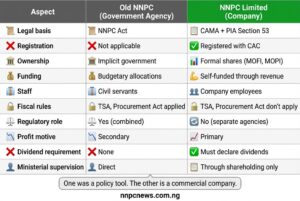
| Aspect | Old NNPC (Government Agency) | NNPC Limited (Company) |
|---|---|---|
| Legal basis | NNPC Act (Decree No. 33 of 1977) | CAMA + PIA Section 53 |
| Registration | Not applicable | Registered with CAC |
| Ownership | Implicit government ownership | Formal shares (MOFI, MOPI) |
| Funding | Budgetary allocations | Self-funded through revenue |
| Staff | Civil servants | Company employees |
| Fiscal rules | TSA, Procurement Act applied | TSA, Procurement Act don’t apply |
| Regulatory role | Yes (combined with commercial) | No (separate agencies) |
| Profit motive | Secondary | Primary |
| Dividend requirement | None | Must declare dividends |
| Ministerial supervision | Direct | Through shareholding only |
The Conclusion
NNPC Limited is a company, not a government agency. The Petroleum Industry Act 2021 dissolved the old statutory corporation and incorporated a new limited liability company under the Companies and Allied Matters Act.
The government remains the sole shareholder through MOFI and MOPI. But ownership is now formalized through shares, not just a law. The company must operate commercially, profitably, and efficiently without recourse to government funds.
This isn’t privatization. The government still owns it. But it’s commercialization. The rules of operation have fundamentally changed. And for Nigerians, that means greater transparency, better accountability, and hopefully, more value from the country’s oil and gas resources.
Official sources for verification:
- • Petroleum Industry Act 2021 on the FAO Legal Database
- • Corporate Affairs Commission (CAC) Official Website
Last updated: March 2026. Information based on Petroleum Industry Act 2021 provisions, CAC records, and official government communications.