

If you’ve been following the news about NNPC Limited, you’ve probably seen headlines about a possible public listing. The company is considering selling shares to the public. But that’s not the same as actually doing it.
The short answer is no. The public cannot currently buy shares in NNPC Limited. All shares are held by government entities as provided in the Petroleum Industry Act 2021.
But the longer answer is more interesting. The law doesn’t forbid public shareholding forever. Section 59 of the PIA contemplates a time when the company may no longer be wholly government-owned. And NNPC Limited is actively planning for an initial public offering.
Here’s what you can and cannot do right now, what the law says, and what the future might hold.
The Short Answer
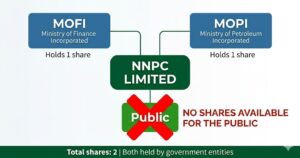
No, the public cannot currently buy shares in NNPC Limited. All shares are held by two government entities:
- Ministry of Finance Incorporated (MOFI) — holds one share
- Ministry of Petroleum Incorporated (MOPI) — holds one share
The federal government is the sole shareholder. There are no shares available for purchase by the public, private investors, or institutions.
If you’re curious about who owns NNPC Limited, the answer is the federal government through MOFI and MOPI. And if you want to understand what NNPC Limited is under the Petroleum Industry Act, the current ownership structure is fully government-controlled.
Current Ownership Structure
Government Shareholding
NNPC Limited has two shareholders. Both are government entities. MOFI represents the Ministry of Finance. MOPI represents the Ministry of Petroleum Resources.
Both hold their shares on behalf of the federation. This structure means the federal government is the sole shareholder. No shares are available for purchase by the public.
The NNPC ownership structure under Nigerian law is designed to maintain government control.
Share Capital Position
NNPC Limited has two shares in total. Both shares are issued and fully paid to the government shareholders.
There are no unissued shares available for purchase. The authorized share capital could potentially be increased, but any new shares would initially be available only to existing shareholders.
The NNPC share capital explained in detail shows why there are no public shares available.
Legal Basis for Current Structure
Section 53(2) of the Petroleum Industry Act specifies that MOFI and MOPI are the initial shareholders. The PIA does not contemplate public shareholding at this stage.
Section 53(5) adds that the shares cannot be transferred or mortgaged unless approved by the government and the National Economic Council. This prevents any sale of shares without proper oversight.
- The difference between NNPC and NNPC Limited in ownership terms is that the old NNPC had no shares at all, while NNPC Limited has shares but they are all government-held.
Why the Public Cannot Buy Shares Now
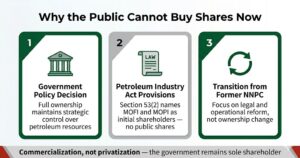
Government Policy Decision
The government decided to maintain full ownership of NNPC Limited. This reflects the strategic importance of petroleum resources to national development.
Petroleum is a critical sector that generates significant revenue for the federation. The government determined that full ownership serves national interest.
The policy choice favors commercialization over privatization. NNPC Limited operates commercially but remains wholly government-owned.
Petroleum Industry Act Provisions
The PIA deliberately structured NNPC Limited as a government-owned entity. It did not include provisions for public share offering or privatization.
The Act focuses on commercialization, which means operating commercially while remaining government-owned. This differs from privatization, which involves selling shares to private investors.
Legislative intent was to improve efficiency through commercial discipline, not to transfer ownership to the public.
Transition from Former NNPC
The former NNPC was a government agency without shares. The transition created NNPC Limited as a commercial company but retained government ownership.
This approach maintains continuity while introducing commercial structures. It avoids the complexities and policy debates that would accompany privatization.
The transition focused on legal and operational reform rather than ownership change.
What the Law Says About Future Public Shareholding
Section 59 of the PIA
The PIA doesn’t require NNPC Limited to remain wholly government-owned forever. Section 59 contemplates that when the company is no longer wholly government-owned, shareholders will appoint directors differently.
This provision acknowledges that ownership could change in the future. It doesn’t mandate change, but it doesn’t prevent it either.
The Restriction on Share Transfers
Section 53(5) requires government and NEC approval for any share transfer. This means the government would have to actively approve any sale of shares to the public.
No sale can happen without proper authorization. This protects against backdoor privatization.
Amendment Possibilities
If the government decides to allow public shareholding, the PIA might need to be amended. Or the government could simply approve a share transfer under Section 53(5).
Either way, public shareholding would require active government approval. It won’t happen automatically.
The objectives and mandate of NNPC would need to be considered in any such decision.

The IPO Planning
What NNPC Limited Has Announced
NNPC Limited is moving closer to a historic public listing, with plans to offer shares to investors on major global exchanges.
The Group Chief Executive Officer, Bayo Ojulari, revealed that the company is considering listings on top financial markets such as the New York Stock Exchange and the London Stock Exchange.
The announcement was made during discussions at CERAWeek by S&P Global in Houston, signalling a major step in NNPC’s transformation into a commercially driven energy company.
Focus on Readiness, Not Speed
Ojulari made it clear that while the listing is a priority, the company will not rush into it. Instead, NNPC is concentrating on building a solid foundation that will attract both local and international investors.
“Our strategy is not just about listing, but about building the right fundamentals, transparency, cost efficiency, and world-class project delivery,” Ojulari said.
He stressed that transparency, operational efficiency and strong corporate governance are critical pillars of the strategy. The goal is to create a company that investors trust and are eager to invest in, rather than simply rushing to the stock market.
What This Means for the Share Capital
If NNPC Limited successfully lists on stock exchanges, the share capital will increase significantly. New shares would be issued to public investors, bringing in fresh capital. The government’s percentage ownership would decrease, but the absolute value of the share capital would grow.
If you’re following who is the GCEO of NNPC, Ojulari’s leadership will be critical to the success of this IPO.

Comparison with Other National Oil Companies
Saudi Aramco
Saudi Aramco completed a partial initial public offering in 2019. The government sold a small percentage of shares while retaining majority control.
The IPO was one of the largest in history, raising significant capital. Shares listed on the Saudi Stock Exchange (Tadawul).
This shows how a major national oil company can partially list while maintaining government control.
Petrobras (Brazil)
Petrobras of Brazil has publicly traded shares with government retaining controlling interest. The company is listed on B3 (Brazil’s stock exchange) and international exchanges.
Public listing has provided access to capital and market discipline. Government retains control through golden shares and majority voting rights.
Equinor (Norway)
Equinor of Norway was partially privatized through public listing. The government retains majority ownership while shares trade on Oslo and New York exchanges.
Listing has supported international expansion and access to capital. Government control ensures alignment with national interests.
The NNPC vs international oil companies comparison shows that public listing is common among national oil companies.
Alternative Forms of Public Participation
Bonds and Debt Instruments
The public can participate in NNPC Limited’s financing through bonds and debt instruments. These do not involve share ownership but provide investment opportunities.
NNPC Limited can issue corporate bonds to raise capital. The public can purchase these bonds and earn interest.
Bonds provide a way for the public to invest without owning shares. They offer fixed returns and do not carry ownership rights.
Investment in Subsidiaries
NNPC Limited’s subsidiaries could potentially offer investment opportunities. Some subsidiaries might partner with private investors or list shares.
This would enable public participation in specific business areas while maintaining full ownership of the parent company.
Subsidiary investment could bring capital and expertise to particular operations. It would not affect ownership of NNPC Limited itself.
Joint Ventures with Private Partners
NNPC Limited enters joint ventures with private companies for specific projects. These partnerships involve private participation in operations but not ownership of NNPC Limited.
Joint ventures enable private capital and expertise to complement NNPC Limited’s resources. They do not change the company’s shareholding structure.
This form of participation is already common in the petroleum sector. It provides benefits of private involvement without share ownership.
The list of NNPC subsidiaries and their functions shows which parts of the group might offer investment opportunities.
Public Misconceptions About NNPC Shares
Confusion with Former NNPC
Some members of the public may confuse NNPC Limited with the former NNPC. The former corporation did not have shares, and the public could not invest.
This misconception persists despite the transition to NNPC Limited. The new company’s share structure is not widely understood.
Clear communication about ownership structure helps address confusion. The public needs accurate information about investment possibilities.
Misunderstanding of Commercialization
Commercialization is sometimes confused with privatization. People may assume that making NNPC a company means shares are available for purchase.
Commercialization means operating commercially while remaining government-owned. It does not automatically lead to public share offering.
Understanding the difference between NNPC and NNPC Limited helps clarify this distinction.
Expectations from Other Countries
Examples from other countries where national oil companies have public shareholders may create expectations. People may assume Nigeria will follow similar paths.
Each country’s approach reflects its unique circumstances. Nigeria’s current model differs from countries that have chosen public participation.
Awareness of different models helps contextualize Nigeria’s choices. It does not guarantee that Nigeria will adopt similar approaches.
What This Means for Nigerians
No Direct Investment Yet
For now, Nigerians cannot buy NNPC shares directly. The company remains wholly government-owned.
Any investment would have to wait for an IPO or other share offering. That hasn’t happened yet.
Transparency Still Applies
Even though the public cannot buy shares, the PIA’s transparency requirements still apply. NNPC Limited must publish audited financial statements annually.
The NNPC financial statements explained show how the company is performing. Nigerians can see the numbers even if they can’t buy the shares.
Future Possibilities
The IPO planning means that public shareholding is a real possibility in the future. When that happens, Nigerians will have the opportunity to invest directly in their national oil company.
The question is no longer if NNPC will go public, but when — and how Nigerians can be part of it.
The can NNPC be privatized question is closely related to this discussion.

Summary: Can the Public Buy NNPC Shares?
| Question | Answer |
|---|---|
| Can the public buy shares now? | No |
| Who currently holds shares? | MOFI and MOPI (government entities) |
| How many shares are available to the public? | Zero |
| Does the law allow future public shareholding? | Yes, Section 59 contemplates it |
| Is NNPC Limited planning an IPO? | Yes, considering NYSE and LSE listings |
| Can Nigerians invest in other ways? | Bonds, subsidiary investments, joint ventures |
Conclusion
No, the public cannot currently buy shares in NNPC Limited. All shares are held by the Ministry of Finance Incorporated and the Ministry of Petroleum Incorporated on behalf of the federation. The government is the sole shareholder. But the law doesn’t forbid public shareholding forever. Section 59 of the PIA contemplates a time when the company may no longer be wholly government-owned. And NNPC Limited is actively planning for an initial public offering, considering listings on the New York Stock Exchange and the London Stock Exchange. The public cannot buy shares today. But that could change. The question is no longer if NNPC will go public, but when — and how Nigerians can be part of it.Official sources for verification:
Last updated: April 2026. Information based on Petroleum Industry Act 2021 provisions, NNPC announcements, and official government communications.