

If you’ve been following the news about NNPC Limited’s planned IPO, you might assume the company is already listed on a stock exchange. It’s not.
The short answer is no. NNPC Limited is not listed on the Nigerian Stock Exchange or any other stock exchange. The company is privately held by government entities with no public trading of its shares.
But the longer answer is that listing is actively being planned. The company is considering listings on major global exchanges. The question isn’t whether NNPC will list, but when and where.
Here’s the current status, the requirements for listing, and what the future might hold.
The Short Answer
No, NNPC Limited is not listed on any stock exchange. The company operates as a private company, not a public one.
The shares are held by two government entities:
- Ministry of Finance Incorporated (MOFI) — holds one share
- Ministry of Petroleum Incorporated (MOPI) — holds one share
There is no public market for trading NNPC Limited shares. Investors cannot purchase NNPC shares through brokerage accounts. There is no ticker symbol or market price for the company.
If you’re curious about who owns NNPC Limited, the answer is the federal government through MOFI and MOPI. And if you want to understand what NNPC Limited is under the Petroleum Industry Act, the current status is a private company.
Current Listing Status
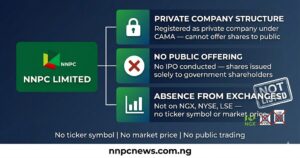
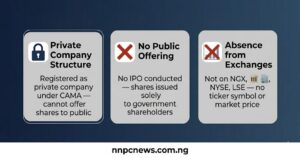
Private Company Structure
NNPC Limited is registered as a private company under the Companies and Allied Matters Act. Private companies cannot offer shares to the public or list on stock exchanges.
The company’s shares are held by two government entities. There is no public market for trading NNPC Limited shares.
Private company status aligns with the government’s decision to maintain full ownership. It restricts share transfer and public participation.
No Public Offering
NNPC Limited has not conducted an initial public offering. There has been no sale of shares to the public or institutional investors.
The company’s capital was established through government subscription rather than public fundraising. Shares were issued solely to government shareholders.
Without a public offering, there are no shares available for trading on exchanges. The company remains wholly government-owned.
Absence from Exchange Listings
NNPC Limited does not appear on the list of companies traded on the Nigerian Exchange Group. It is not listed on any international stock exchange.
Investors cannot purchase NNPC Limited shares through brokerage accounts or trading platforms. There is no ticker symbol or market price for the company.
The difference between NNPC and NNPC Limited includes this status — neither version has ever been publicly listed.
Why NNPC Limited Is Not Listed
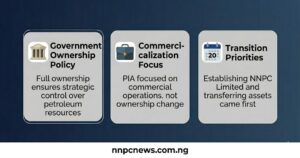
Government Ownership Policy
The government has chosen to maintain full ownership of NNPC Limited. Listing would require selling shares to the public, reducing government control.
Full ownership ensures strategic alignment with national petroleum policy. It prevents private interests from influencing company direction.
The policy reflects the view that petroleum resources are too important for private control. Government retains direct authority over the national oil company.
Commercialization Focus
The Petroleum Industry Act focused on commercialization rather than privatization. NNPC Limited was created to operate commercially, not to be sold to the public.
Commercialization improves efficiency through commercial discipline. It does not require changing ownership structure.
The PIA’s objectives can be achieved without listing. NNPC Limited can operate commercially while remaining government-owned.
Transition Priorities
The immediate priority after PIA enactment was establishing NNPC Limited and transferring assets. Listing was not part of this transition phase.
Implementation focused on creating the legal entity, governance structures, and operational framework. Ownership changes would have complicated the transition.
Stabilizing the new company took precedence over ownership changes. Listing can be considered later if policy evolves.
The objectives and mandate of NNPC were focused on commercialization, not public listing.
Listing Requirements
Conversion to Public Company
NNPC Limited would need to convert from private to public company status. This requires amending its memorandum and articles of association.
Public company status imposes additional regulatory obligations. It also removes restrictions on share transfers and public offerings.
Conversion requires shareholder approval and compliance with CAMA procedures. It represents a fundamental change in company structure.
Initial Public Offering
Listing requires conducting an initial public offering to sell shares to the public. The IPO involves preparing a prospectus, marketing shares, and setting offering price.
IPO process requires extensive disclosure about company operations, finances, and risks. It demands significant preparation and professional advice.
Success depends on investor demand and market conditions. Poor execution could affect valuation and market reception.
Corporate Governance Enhancements
Listed companies must meet enhanced corporate governance standards. This includes independent directors, board committees, and internal controls.
Governance requirements protect public shareholders and ensure proper oversight. They exceed standards applicable to private companies.
NNPC Limited would need to strengthen governance arrangements for listing. This includes board composition and accountability mechanisms.
The NNPC board of directors and their roles would need to evolve for public listing.
Financial Reporting Standards
Listed companies must comply with International Financial Reporting Standards. They must publish quarterly and annual reports with detailed disclosures.
Financial reporting for listed companies is more demanding than for private companies. It requires robust systems and professional expertise.
NNPC Limited already publishes audited financial statements under the PIA. Listing would require more frequent and detailed reporting.
The NNPC financial statements explained show current reporting standards, but listing would demand more.
Regulatory Approvals
Listing requires approvals from the Securities and Exchange Commission and the stock exchange. These regulators review offering documents and company qualifications.
Approval processes ensure investor protection and market integrity. They involve scrutiny of company affairs and disclosures.
Regulatory approvals can take time and require significant preparation. They add to the complexity of listing.
The IPO Planning
What NNPC Limited Has Announced
NNPC Limited is moving closer to a historic public listing, with plans to offer shares to investors on major global exchanges.
The Group Chief Executive Officer, Bayo Ojulari, revealed that the company is considering listings on top financial markets such as the New York Stock Exchange and the London Stock Exchange.
The announcement was made during discussions at CERAWeek by S&P Global in Houston, signalling a major step in NNPC’s transformation into a commercially driven energy company.
If you’re following who is the GCEO of NNPC, Ojulari’s leadership will be critical to this process.
Focus on Readiness, Not Speed
Ojulari made it clear that while the listing is a priority, the company will not rush into it. Instead, NNPC is concentrating on building a solid foundation that will attract both local and international investors.
“Our strategy is not just about listing, but about building the right fundamentals, transparency, cost efficiency, and world-class project delivery,” Ojulari said.
He stressed that transparency, operational efficiency and strong corporate governance are critical pillars of the strategy.
What This Means for Listing
The IPO planning means that NNPC Limited is actively preparing for listing. The company is not listed yet, but it is working toward that goal.
The question is no longer if NNPC will list, but when and where. The NYSE and LSE are under consideration, but other exchanges could also be options.
The can NNPC be privatized question is closely related to this listing discussion.

International Examples
Saudi Aramco
Saudi Aramco completed a partial initial public offering in 2019. The government sold a small percentage of shares while retaining majority control.
The IPO was one of the largest in history, raising significant capital. Shares listed on the Saudi Stock Exchange (Tadawul).
This example shows how a major national oil company can partially list while maintaining government control.
Petrobras (Brazil)
Petrobras of Brazil has publicly traded shares with government retaining controlling interest. The company is listed on B3 (Brazil’s stock exchange) and international exchanges.
Public listing has provided access to capital and market discipline. Government retains control through golden shares and majority voting rights.
Equinor (Norway)
Equinor of Norway was partially privatized through public listing. The government retains majority ownership while shares trade on Oslo and New York exchanges.
Listing has supported international expansion and access to capital. Government control ensures alignment with national interests.
The NNPC vs international oil companies comparison shows that public listing is common among national oil companies.
Benefits of Listing
Access to Capital
Listing would provide access to public capital markets. NNPC Limited could raise funds for investment through share issuance.
Public equity complements debt financing and internally generated funds. It provides permanent capital without repayment obligations.
Access to capital could accelerate development of refineries, pipelines, and gas projects. It would reduce reliance on government funding.
Market Discipline
Listing introduces market discipline through public shareholders. Management must perform to maintain share price and investor confidence.
Public scrutiny encourages efficiency and transparency. It aligns management interests with shareholder value creation.
Market discipline complements government oversight. It provides additional accountability mechanisms.
Valuation Benchmark
Listing establishes a market valuation for NNPC Limited. Share price provides real-time assessment of company performance and prospects.
Valuation benchmark supports informed decision-making by government and stakeholders. It reveals market perception of company value.
Public valuation can guide policy and investment decisions. It provides objective measure of success.
Public Participation
Listing enables public participation in Nigeria’s oil and gas sector. Citizens can invest in the national oil company and share in its success.
Public ownership aligns citizen interests with company performance. It creates broader stakeholder support for the company.
Participation through share ownership differs from taxation and revenue sharing. It gives citizens direct stake in company performance.
Summary: Is NNPC Listed?
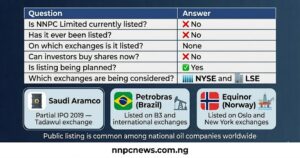
| Question | Answer |
|---|---|
| Is NNPC Limited currently listed? | No |
| Has it ever been listed? | No |
| On which exchanges is it listed? | None |
| Can investors buy shares now? | No |
| Is listing being planned? | Yes |
| Which exchanges are being considered? | NYSE and LSE |
The Conclusion
No, NNPC Limited is not listed on the Nigerian Stock Exchange or any other stock exchange. The company is privately held by government entities with no public trading of its shares. But the company is actively planning for a historic public listing. The Group Chief Executive Officer, Bayo Ojulari, has announced that NNPC Limited is considering listings on major global exchanges including the New York Stock Exchange and the London Stock Exchange. The question is no longer if NNPC will list, but when and where. The company is focusing on building the right fundamentals before rushing to market. For investors, the message is clear: NNPC shares are not available today, but they may be in the future.Official sources for verification:
Last updated: April 2026. Information based on Petroleum Industry Act 2021 provisions, NNPC announcements, and official government communications.