
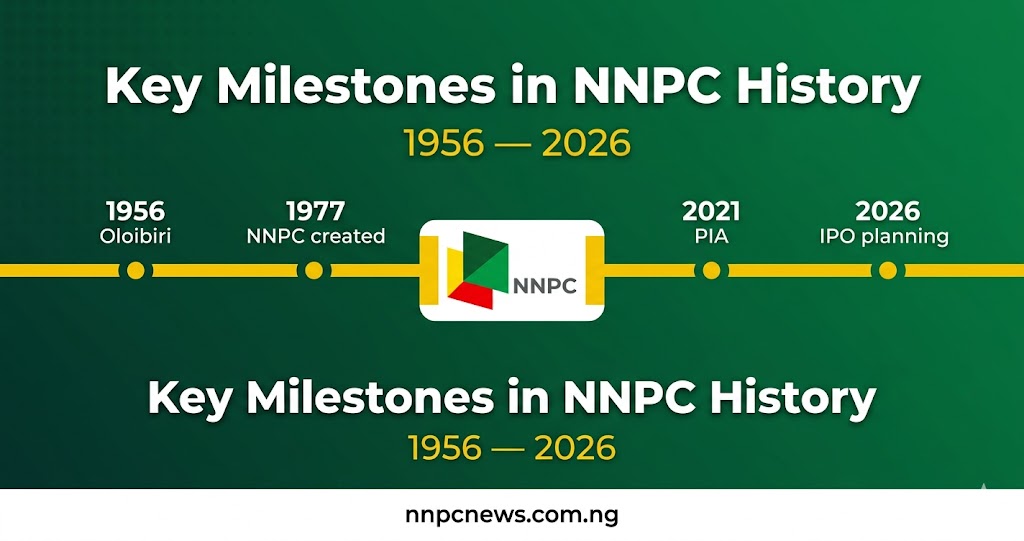
If you want to understand NNPC, you need to understand the moments that shaped it. Not the gradual drift, but the specific points where things changed.
A decree signed here. A discovery made there. A bill stuck in parliament for 14 years, then finally passed. Each milestone tells you something about why NNPC is the way it is today.
Here are the key milestones that defined NNPC — from its birth in 1977 to the IPO planning underway in 2026.
1956: Oil Discovered at Oloibiri
Before NNPC, there was oil. But without the discovery, none of this happens.
Shell-BP Petroleum Development Company found oil in commercial quantities at Oloibiri in present-day Bayelsa State. Nigeria was still under colonial rule. Independence came in 1960.
But the discovery set everything in motion. Within two decades, oil would become the dominant source of government revenue. And the government would realize it needed its own institution to manage the industry.
Understanding when NNPC was established starts here — because the discovery made the institution necessary.
1971: Nigerian National Oil Corporation (NNOC) Established
The first direct state participation in oil came in 1971. The government established the Nigerian National Oil Corporation (NNOC).
NNOC entered joint ventures with international oil companies. It acquired equity stakes in producing fields. It began building local expertise.
But NNOC only handled commercial operations. Regulation stayed with the Federal Ministry of Mines and Power. This separation created coordination problems that would later lead to NNPC’s creation.
1977: NNPC Created by Decree No. 33
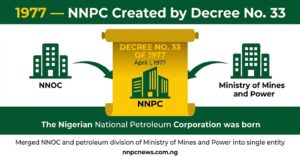
This is the big one. On April 1, 1977, the government issued Decree No. 33, merging NNOC and the petroleum division of the Ministry of Mines and Power into a single entity.
The Nigerian National Petroleum Corporation was born.
The decree gave NNPC powers to explore, produce, refine, transport, market, and regulate. For the first time, Nigeria had a unified national oil company.
The difference between NNPC and NNPC Limited starts with this moment — the old corporation was created by decree. The new company was created by the PIA.
1978: Warri Refinery Completed
One of NNPC’s first priorities was refining. Nigeria had one refinery in Port Harcourt (built in 1965). It wasn’t enough.
The Warri refinery was completed in 1978. It added 125,000 barrels per day of capacity. The goal was to make Nigeria self-sufficient in petroleum products.
That goal was never fully achieved. But the refinery network became a key part of NNPC’s infrastructure.
1980: Kaduna Refinery Completed
The Kaduna refinery followed in 1980. It added 110,000 barrels per day of capacity, bringing total refining capacity to about 270,000 barrels per day.
Unlike the coastal refineries in Port Harcourt and Warri, Kaduna was inland. It processed both domestic crude and imported condensate, serving markets in the north.
Today, understanding NNPC refineries locations and status means knowing that all three refineries have operated below capacity for decades — a problem that began almost as soon as they were built.
1988: NNPC Restructured with Subsidiaries
The government restructured NNPC in 1988. The goal was to improve efficiency and commercial focus.
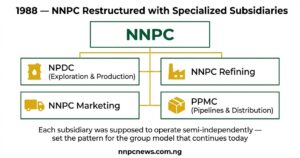
The restructuring created specialized subsidiaries:
- Nigerian Petroleum Development Company (NPDC) — exploration and production
- NNPC Refining — refinery operations
- NNPC Marketing — product sales
- Pipelines and Products Marketing Company (PPMC) — distribution
Each subsidiary was supposed to operate semi-independently. In practice, they remained under strong central control. But the structure set the pattern for the group model that continues today.
1990s: Production Sharing Contracts (PSCs) Introduced
By the 1990s, Nigeria had explored most of its onshore and shallow water areas. The remaining potential was in deepwater — expensive, risky, technically challenging.
The joint venture model required NNPC to pay its share of costs. For deepwater, that was too expensive. The government couldn’t afford it.
The solution was Production Sharing Contracts (PSCs). Under PSCs, international oil companies bear the exploration risk. If they find oil, they recover costs from production and share the remaining profit with NNPC.
This framework opened deepwater Nigeria and changed NNPC’s role from active operator to concessionaire and profit-taker.
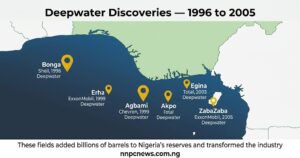
1996: Bonga Deepwater Discovery
Bonga was the first major deepwater discovery in Nigeria. Shell found the field in 1996.
Bonga proved that deepwater Nigeria was commercially viable. It opened the floodgates for other discoveries. Production began in 2005.
Understanding NNPC production levels explained requires knowing that deepwater fields like Bonga now account for a significant portion of Nigeria’s output.
1999: First NLNG Exports
The Nigeria LNG project achieved first exports from Bonny Island in 1999. NNPC holds 49 percent, with international partners holding the rest.
NLNG commercialized gas that was previously flared. It created a new revenue stream and reduced environmental damage.
Today, NLNG is one of Nigeria’s most successful industrial projects. The NNPC LNG investments explained show how this venture became a model for gas commercialization.
1999: Erha, Agbami Deepwater Discoveries
Two more major deepwater discoveries came in 1999. ExxonMobil found Erha. Chevron found Agbami.
These fields added billions of barrels to Nigeria’s reserves. They also cemented the PSC model as the framework for deepwater development.
2000: Akpo Discovery
Total discovered Akpo in 2000. It was another major deepwater field, with significant gas reserves as well as oil.
Akpo came on stream in 2009. It demonstrated the potential for deepwater gas development.
2003: Egina Discovery
Total discovered Egina in 2003. It was one of the largest deepwater discoveries in Nigeria, with over 500 million barrels of recoverable oil.
Egina came on stream in 2018. The floating production unit used for Egina was the largest ever built by Total.
2005: ZabaZaba Discovery
ExxonMobil discovered ZabaZaba in 2005. It was another major deepwater find, adding to Nigeria’s reserve base.
By this point, deepwater production was becoming the main driver of Nigerian oil output. The fields discovered in the 1990s and 2000s are still producing today.
2007: Petroleum Industry Bill (PIB) First Introduced
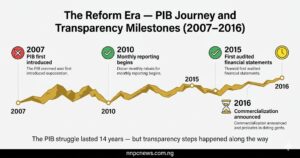
Efforts to reform NNPC and the broader petroleum sector began in earnest in the early 2000s. The Petroleum Industry Bill was introduced to the National Assembly in 2007.
The PIB proposed sweeping changes: breaking up NNPC into separate entities, creating independent regulators, introducing new fiscal terms, and increasing transparency.
But the PIB got stuck. For 14 years, it went through multiple versions. Each administration had its own priorities. The National Assembly couldn’t agree.
2010: NNPC Begins Monthly Reporting
Despite legislative gridlock, NNPC took some steps toward transparency. In 2010, it began publishing monthly financial and operational reports.
These reports provided public access to information about production, revenue, and expenditures. They were a significant step forward, even though they weren’t audited.
2015: First Audited Financial Statements Published
In 2015, NNPC published audited financial statements for 2014 — the first time in its 38-year history. Previously, NNPC had never made its accounts public.
The NNPC financial statements explained show how much was hidden for so long. This publication was a turning point for transparency.
2016: Commercialization Announced
The government announced plans to commercialize NNPC in 2016. The goal was to transform it from a government agency into a commercial entity.
The announcement was greeted with skepticism. Nigerians had heard reform promises before. But this time was different — the plan was tied to the pending PIB.
2021: Petroleum Industry Act Signed (August 16)
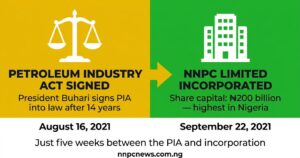
On August 16, 2021, President Muhammadu Buhari signed the Petroleum Industry Act into law. After 14 years of legislative struggle, the PIB finally became the PIA.
The Act fundamentally restructured Nigeria’s petroleum sector. It created new regulatory agencies, introduced new fiscal terms, and dissolved the old NNPC.
If you’re trying to understand what NNPC Limited is under the Petroleum Industry Act, this is the moment it all changed.
2021: NNPC Limited Incorporated (September 22)
Just five weeks after the PIA was signed, NNPC Limited was incorporated with the Corporate Affairs Commission.
The company was registered with a share capital of ₦200 billion — the highest in Nigeria at the time. The shares were held by the Ministry of Finance Incorporated (MOFI) and the Ministry of Petroleum Incorporated (MOPI), each holding one share on behalf of the federation.
2022: Asset Transfer Completed
Section 54 of the PIA provided for the transfer of assets and liabilities from the old NNPC to NNPC Limited. The Minister of Petroleum and Minister of Finance were given 18 months to determine what gets transferred.
If they didn’t complete the transfer within 18 months, everything was deemed automatically transferred. The law didn’t allow bureaucracy to block the transition.
The transfer was completed in 2022. The old NNPC ceased to exist.
2025: Leadership Overhaul Under President Tinubu
In April 2025, President Tinubu dissolved the existing board of NNPC Limited and appointed new leadership. Bayo Ojulari became Group Chief Executive Officer. Ahmadu Musa Kida became board chairman.
The new 11-member board included representatives from all six geopolitical zones. The overhaul demonstrated that ultimate control rests with the President, who appoints directors under Section 59(2) of the PIA.
If you’re tracking leadership, knowing who is the GCEO of NNPC matters for understanding where the company is headed.

2026: IPO Planning Underway
The most recent milestone. NNPC Limited is moving closer to a historic public listing, with plans to offer shares to investors on major global exchanges.
The Group Chief Executive Officer, Bayo Ojulari, revealed that the company is considering listings on top financial markets such as the New York Stock Exchange and the London Stock Exchange.
The announcement was made during discussions at CERAWeek by S&P Global in Houston, signalling a major step in NNPC’s transformation into a commercially driven energy company.
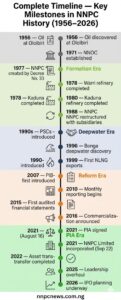
Key Milestones Timeline
| Year | Milestone |
|---|---|
| 1956 | Oil discovered at Oloibiri |
| 1971 | NNOC established |
| 1977 | NNPC created by Decree No. 33 |
| 1978 | Warri refinery completed |
| 1980 | Kaduna refinery completed |
| 1988 | NNPC restructured with subsidiaries |
| 1990s | PSCs introduced |
| 1996 | Bonga deepwater discovery |
| 1999 | First NLNG exports |
| 1999 | Erha and Agbami discoveries |
| 2000 | Akpo discovery |
| 2003 | Egina discovery |
| 2005 | ZabaZaba discovery |
| 2007 | PIB first introduced |
| 2010 | Monthly reporting begins |
| 2015 | First audited financial statements |
| 2016 | Commercialization announced |
| 2021 | PIA signed (August 16) |
| 2021 | NNPC Limited incorporated (September 22) |
| 2022 | Asset transfer completed |
| 2025 | Leadership overhaul |
| 2026 | IPO planning underway |
What These Milestones Tell Us
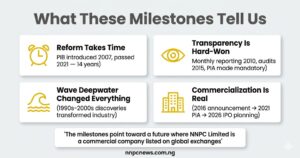
Reform Takes Time
The PIB was introduced in 2007 and passed in 2021. Fourteen years. Reform is possible, but it takes patience, persistence, and sometimes, decades.
Transparency Is Hard-Won
NNPC resisted transparency for most of its history. Monthly reporting began in 2010. Audited accounts came in 2015. The PIA made it mandatory. Each step was fought for.
Deepwater Changed Everything
The deepwater discoveries of the 1990s and 2000s transformed Nigeria’s oil industry. PSCs replaced joint ventures as the dominant model. NNPC’s role shifted from operator to concessionaire.
Commercialization Is Real
The 2016 commercialization announcement, the 2021 PIA, the 2022 asset transfer, the 2025 leadership overhaul, and the 2026 IPO planning all point in one direction: NNPC Limited is now a commercial company.
Conclusion
The key milestones in NNPC history tell the story of Nigeria’s oil industry. From the discovery at Oloibiri in 1956 to the creation of NNOC in 1971 to the birth of NNPC in 1977, each milestone marked a step toward greater state control.
The deepwater discoveries of the 1990s and 2000s changed the industry. The PIB struggle from 2007 to 2021 showed how hard reform can be. The PIA passage and NNPC Limited incorporation in 2021 marked the most fundamental change yet.
The 2025 leadership overhaul and 2026 IPO planning show that the transformation continues. The milestones are history. But they point toward a future where NNPC Limited is a commercial company listed on global exchanges, accountable to shareholders, and measured by profit and performance.
Official sources for verification:
Last updated: March 2026. Information based on Petroleum Industry Act 2021 provisions, NNPC historical records, and official government communications.