
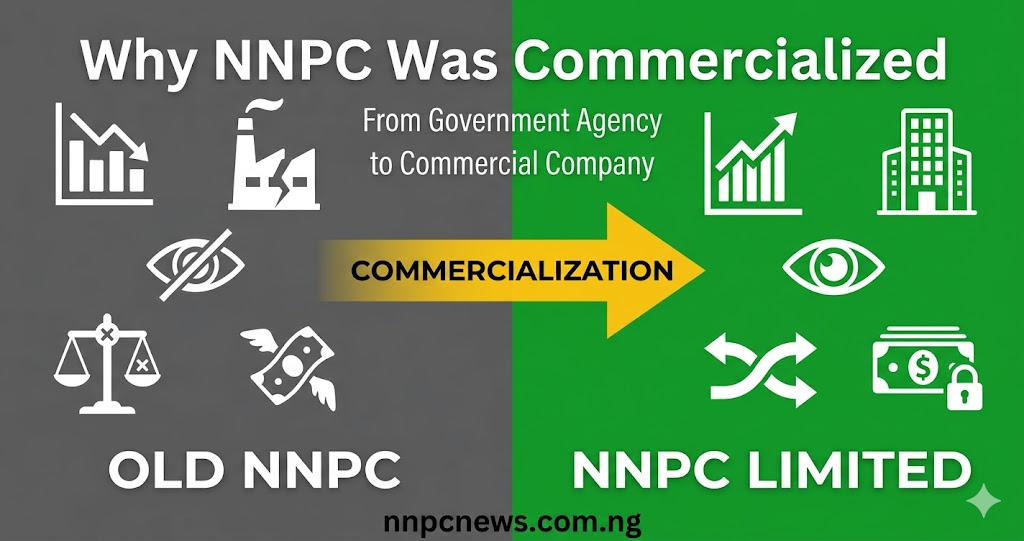
For over forty years, NNPC operated as a government agency. Budgetary allocations. Civil service rules. Ministerial supervision. The model was familiar. It was also broken.
The refineries didn’t work. The books weren’t published. The revenue didn’t always reach the federation account. And every attempt at reform seemed to get stuck in the same political gridlock.
By 2016, the government had a clear choice: keep doing what wasn’t working, or fundamentally change the model.
They chose change. The Petroleum Industry Act 2021 commercialized NNPC. Here’s why.
The Short Version
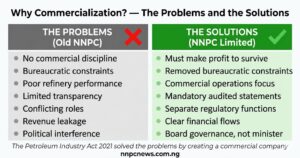
NNPC was commercialized because the old model wasn’t working. As a government agency, it lacked commercial discipline, faced bureaucratic constraints, suffered from limited transparency, and was caught in a conflict between its commercial and regulatory roles.
The Petroleum Industry Act 2021 solved these problems by creating NNPC Limited — a commercial company with shareholders, a board of directors, and a legal obligation to make profit. The government remains the owner. But the rules of operation are fundamentally different.
If you’re trying to understand what NNPC Limited is under the Petroleum Industry Act, the “why” is just as important as the “what.”
The Problems with the Old Model
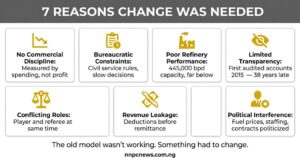
No Commercial Discipline
As a government agency, NNPC didn’t need to make profit to survive. It received budgetary allocations regardless of performance. If it ran out of money, it asked for more.
This created no incentive for efficiency. No pressure to cut costs. No reason to pursue profitable opportunities aggressively. The organization was measured by how much it spent, not how much it earned.
The difference between NNPC and NNPC Limited starts here. One was a policy tool. The other is a commercial company.
Bureaucratic Constraints
NNPC operated under civil service rules. Procurement processes followed public service requirements. Decisions required multiple approvals. Contracts took months to finalize.
This worked for a government ministry. It didn’t work for an oil company competing with Shell, ExxonMobil, and TotalEnergies. International partners found the bureaucracy frustrating. Projects stalled. Opportunities were missed.
Poor Refinery Performance
NNPC owned four refineries with combined capacity of 445,000 barrels per day. For most of their existence, they operated far below capacity. Turnaround maintenance projects didn’t restore reliable operations.
The result: Nigeria depended on imported fuel. The country with the largest oil reserves in Africa couldn’t refine its own petrol. The NNPC refineries locations and status tell a story of missed potential.
Limited Transparency
For most of its history, NNPC didn’t publish audited financial statements. The first time it did was 2015 — 38 years after it was created.
This lack of transparency made accountability difficult. How much revenue was generated? How much was remitted? How much was lost to inefficiency or worse? Without audited accounts, no one could say for sure.
The NNPC financial statements explained show how much was hidden for so long.
Conflicting Roles
The old NNPC both participated in the industry and regulated it. It held equity in joint ventures, operated refineries, marketed products — and also issued permits, monitored compliance, and enforced regulations.
This created obvious conflicts. Could a regulator be impartial when it was also a commercial player? The answer was no.
Revenue Leakage
The combination of limited transparency, bureaucratic inefficiency, and conflicting roles created conditions for revenue leakage. Money that should have reached the federation account was often delayed, deducted, or diverted.
The February 2026 Executive Order that stripped NNPC of powers to deduct revenue before remitting to the Federation Account was a direct response to this problem. The government’s stated reason: “over two-thirds of potential remittances were being diverted through various deductions and charges.”
Political Interference
As a government agency, NNPC was vulnerable to political pressure. Fuel prices were set based on politics, not economics. Staffing decisions reflected political considerations. Projects were approved based on who asked, not what made business sense.
The challenges facing NNPC Limited today are partly about overcoming this legacy.
The Commercialization Solution
What Commercialization Means
Commercialization means transforming NNPC from a government agency into a commercial entity. Not privatization — the government still owns it. But the operating model changes completely.
Under commercialization, NNPC Limited:
- Must make profit to survive
- Is funded through internally generated revenue, not budgets
- Employs company staff, not civil servants
- Is governed by a board of directors, not a minister
- Publishes audited financial statements annually
- Pays taxes and declares dividends
The objectives and mandate of NNPC were rewritten to reflect this new commercial focus.
How the PIA Achieved This
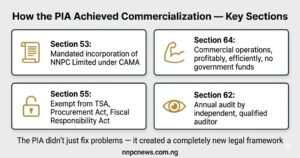
Section 53 of the Petroleum Industry Act mandated the incorporation of NNPC Limited under the Companies and Allied Matters Act. The old NNPC was dissolved. A new company took its place.
Section 64 requires NNPC Limited to carry out petroleum operations on a commercial basis, profitably and efficiently, without recourse to government funds.
Section 55 exempts NNPC Limited from the Fiscal Responsibility Act, the Public Procurement Act, and the Treasury Single Account. These rules were designed for government agencies, not commercial companies.
Section 62 requires annual audit by an independent, qualified auditor. Transparency is no longer optional.
The NNPC ownership structure under Nigerian law was formalized through shares held by MOFI and MOPI.
What Commercialization Was Supposed to Fix
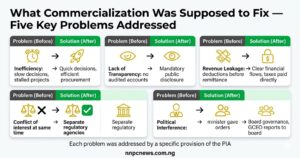
Inefficiency
The old NNPC was inefficient. Procurement took too long. Decisions moved too slowly. Projects were delayed.
Commercialization was supposed to fix this by removing bureaucratic constraints. NNPC Limited can now operate like a real company — making decisions quickly, procuring efficiently, and responding to market opportunities.
Early results are promising. In 2025, NNPC Limited recorded total revenue of ₦60.5 trillion and profit after tax of ₦3.76 trillion. These numbers would have been unimaginable under the old structure.
Lack of Transparency
The old NNPC was opaque. Financial statements were rarely published. Information was hard to get.
Commercialization was supposed to fix this by requiring audited accounts and public disclosure. The PIA made this mandatory.
Now Nigerians can see what’s happening with their oil money. The numbers are public. The performance is measurable. The accountability is real.
Revenue Leakage
The old NNPC had revenue leakage. Money that should have reached the federation account often didn’t.
Commercialization was supposed to fix this by creating clear financial flows. NNPC Limited pays taxes, royalties, and dividends. What’s left after costs is remitted to the federation.
The February 2026 Executive Order went further, eliminating the 30 percent management fee on profit oil from production sharing contracts. Now royalties and taxes must be paid directly to fiscal authorities by contractors.
Conflict of Interest
The old NNPC was both player and referee. This conflict undermined trust and accountability.
Commercialization was supposed to fix this by separating functions. The PIA created new regulatory agencies — the Nigerian Upstream Petroleum Regulatory Commission and the Nigerian Midstream and Downstream Petroleum Regulatory Authority.
NNPC Limited now focuses exclusively on commercial operations. Regulation is handled by independent bodies. Knowing who regulates NNPC now means understanding these separate agencies.
Political Interference
The old NNPC was vulnerable to political pressure. Fuel prices, staffing, contracts — all were influenced by politics.
Commercialization was supposed to fix this by creating distance. NNPC Limited is governed by a board of directors, not a minister. The Group Chief Executive Officer reports to the board, not to the government.
The April 2025 leadership changes demonstrated this new model. President Tinubu, acting as shareholder, appointed new board members and GCEO. He didn’t issue direct operational orders.
If you’re tracking leadership, knowing who is the GCEO of NNPC matters for understanding how this new governance model works.
The Results So Far
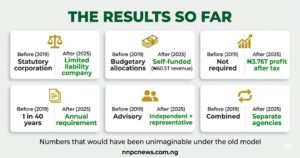
| Metric | Before Commercialization (2019) | After Commercialization (2025) |
|---|---|---|
| Legal status | Statutory corporation | Limited liability company |
| Funding | Budgetary allocations | Self-funded (₦60.5T revenue) |
| Profit reporting | Not required | ₦3.76T profit after tax |
| Audited statements | 1 in 40 years | Annual requirement |
| Board structure | Advisory | Independent + representative |
| Regulatory role | Combined | Separate agencies |
These numbers tell a story. Commercialization has already delivered results that would have been unimaginable under the old model.
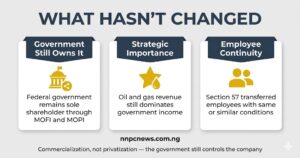
What Didn’t Change
Government Ownership
Despite commercialization, NNPC Limited is still wholly owned by the federal government. The government is the sole shareholder through MOFI and MOPI.
This isn’t privatization. It’s commercialization. The government still controls the company. But control is now exercised through shareholding and board appointments, not direct ministerial supervision.
If you’re curious about who owns NNPC Limited, the answer is still the federal government. But the relationship is different.
Strategic Importance
NNPC Limited remains strategically important to Nigeria’s economy. Oil and gas revenue still dominates government income. Fuel supply still affects every Nigerian.
The company’s mandate includes ensuring national energy security. That strategic role hasn’t changed, even if the legal structure has.
Employee Continuity
Section 57 of the PIA transferred all employees of NNPC and its subsidiaries to NNPC Limited with the same or similar conditions of service they had before.
Over time, employment terms will shift toward company norms. But the transition preserved continuity.
What Commercialization Means for Nigerians
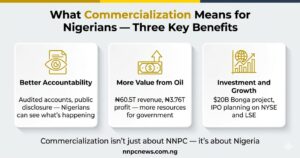
Better Accountability
With audited accounts and public disclosure, Nigerians can finally see what’s happening with their oil money. The old opacity is gone. The numbers are public. The performance is measurable.
When NNPC Limited fails to perform, shareholders (the government) can demand changes. The April 2025 board overhaul was an example of this accountability in action.
More Value from Oil
Commercialization is designed to extract more value from Nigeria’s oil and gas resources. Profit discipline, efficiency, and transparency should lead to higher revenues and better management.
The early results are promising. ₦60.5 trillion in revenue. ₦3.76 trillion in profit. These numbers translate into more resources for government services and development.
Investment and Growth
As a commercial entity, NNPC Limited can attract investment in ways the old agency couldn’t. The $20 billion Bonga Southwest deepwater project moving forward is one example of renewed confidence.
The planned public listing on exchanges like NYSE and LSE is only possible because NNPC Limited is now a company. That listing, when it happens, will open new doors for investment and growth.
The Conclusion
NNPC was commercialized because the old model wasn’t working. As a government agency, it lacked commercial discipline, faced bureaucratic constraints, suffered from limited transparency, and was caught in a conflict between its commercial and regulatory roles.
The Petroleum Industry Act 2021 solved these problems by creating NNPC Limited — a commercial company with shareholders, a board of directors, and a legal obligation to make profit. The government remains the owner. But the rules of operation are fundamentally different.
The results so far are promising. Revenue is up. Profit is being reported. Transparency is improving. And the company is positioning itself for a public listing that would mark the next phase of its transformation.
Commercialization wasn’t an end in itself. It was a means to an end: a more efficient, transparent, and profitable NNPC that delivers more value for Nigeria. The work continues.
Official sources for verification:
Last updated: March 2026. Information based on Petroleum Industry Act 2021 provisions, NNPC financial reports, and official government communications.