If you look at NNPC today, it’s easy to think the transformation happened overnight. The Petroleum Industry Act passed. NNPC Limited incorporated. Everything changed.
But that’s not how reform works. Real change takes time. Decades, sometimes.
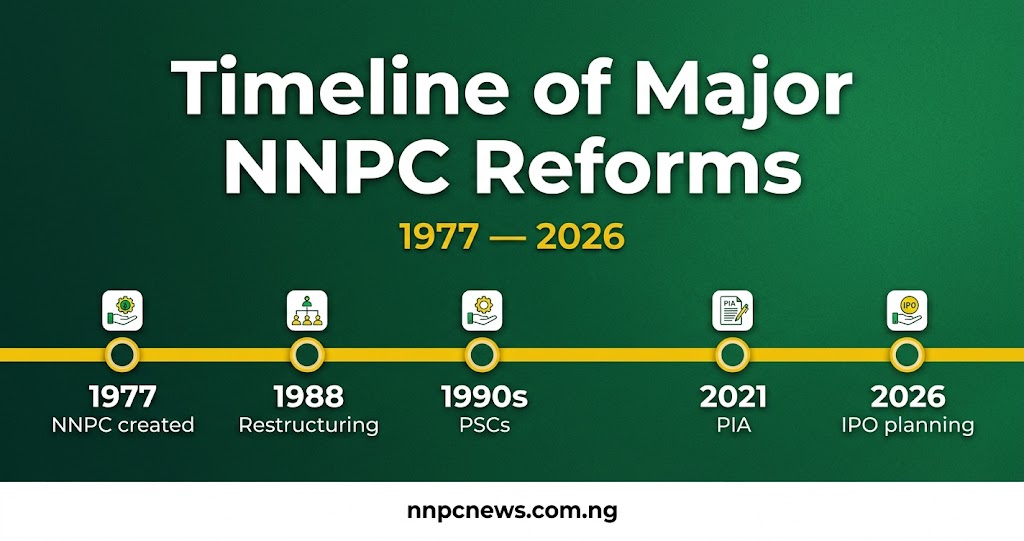
The timeline of NNPC reforms stretches from 1977 to 2026. Each reform built on what came before. Some succeeded. Some failed. But each taught something that shaped the next attempt.
Here’s the full timeline of major NNPC reforms — what happened, why it mattered, and how it led to where we are today.
1977: The Birth of NNPC
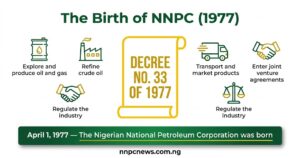
The first major reform was the creation of NNPC itself. On April 1, 1977, the government issued Decree No. 33, merging the Nigerian National Oil Corporation (NNOC) and the petroleum division of the Ministry of Mines and Power.
For the first time, Nigeria had a unified national oil company. NNPC was given powers to explore, produce, refine, transport, market, and regulate. It was a statutory corporation — a government agency, not a company.
This reform was necessary because the previous structure had NNOC handling commercial operations while the Ministry handled regulation. The separation created coordination problems. The merger was supposed to fix that.
Understanding when NNPC was established starts here — 1977 was the beginning.
The Birth of NNPC — Decree No. 33 of 1977
1988: Restructuring into Subsidiaries
The government restructured NNPC in 1988. The goal was to improve efficiency and commercial focus.
The restructuring created specialized subsidiaries:
Nigerian Petroleum Development Company (NPDC) — exploration and production
NNPC Refining — refinery operations
NNPC Marketing — product sales
Pipelines and Products Marketing Company (PPMC) — distribution
Each subsidiary was supposed to operate semi-independently. In practice, they remained under strong central control. But the structure set the pattern for the group model that continues today.
1990s: Introduction of Production Sharing Contracts (PSCs)
By the 1990s, Nigeria had explored most of its onshore and shallow water areas. The remaining potential was in deepwater — expensive, risky, technically challenging.
The joint venture model required NNPC to pay its share of costs. For deepwater, that was too expensive. The government couldn’t afford it.
The solution was Production Sharing Contracts (PSCs). Under PSCs, international oil companies bear the exploration risk. If they find oil, they recover costs from production and share the remaining profit with NNPC.
This reform opened deepwater Nigeria. Major discoveries followed: Bonga (1996), Erha (1999), Agbami (1999), Akpo (2000), Egina (2003). These fields added billions of barrels to Nigeria’s reserves and changed NNPC’s role from active operator to concessionaire and profit-taker.
The NNPC production levels explained today are largely driven by these deepwater fields.
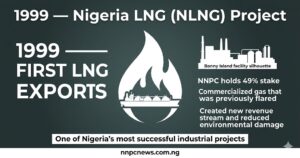
1999 — Nigeria LNG (NLNG) Project
1999: Nigeria LNG (NLNG) Project
The Nigeria LNG project achieved first exports in 1999. NNPC holds 49 percent, with international partners holding the rest.
This reform commercialized gas that was previously flared. It created a new revenue stream and reduced environmental damage. NLNG became a model for gas commercialization in Nigeria.
The NNPC LNG investments explained show how this venture became one of Nigeria’s most successful industrial projects.
2007: Petroleum Industry Bill (PIB) First Introduced
Efforts to reform NNPC and the broader petroleum sector began in earnest in the early 2000s. The Petroleum Industry Bill was introduced to the National Assembly in 2007.
The PIB proposed sweeping changes:
Breaking up NNPC into separate entities
Creating independent regulators
Introducing new fiscal terms
Increasing transparency
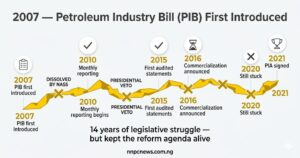
The PIB was ambitious. It was also controversial. For 14 years, it went through multiple versions. Each administration had its own priorities. The National Assembly couldn’t agree.
But the PIB kept the reform agenda alive. Even when it was stuck, it shaped discussions and built momentum.
2007 — Petroleum Industry Bill (PIB) First Introduced
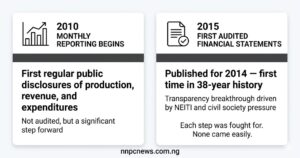
2010: Monthly Reporting Begins
Despite legislative gridlock, NNPC took some steps toward transparency. In 2010, it began publishing monthly financial and operational reports.
These reports provided public access to information about production, revenue, and expenditures. They were a significant step forward, even though they weren’t audited.
This reform was driven by pressure from civil society and international partners. It showed that transparency was possible, even without a new law.
2015: First Audited Financial Statements Published
In 2015, NNPC published audited financial statements for 2014 — the first time in its 38-year history. Previously, NNPC had never made its accounts public.
This was a major transparency reform. The NNPC financial statements explained show how much was hidden for so long. This publication was a turning point.
It was driven by the Nigeria Extractive Industries Transparency Initiative (NEITI) and sustained pressure from civil society.
2010–2015 — Transparency Reforms
2016: Commercialization Announced
The government announced plans to commercialize NNPC in 2016. The goal was to transform it from a government agency into a commercial entity.
The announcement was greeted with skepticism. Nigerians had heard reform promises before. But this time was different — the plan was tied to the pending PIB.
The government made clear that the old NNPC would not survive the new law. This reform set the stage for what came next.
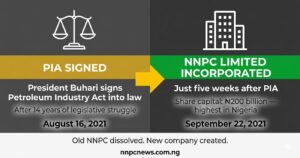
2021: Petroleum Industry Act (PIA) Signed
On August 16, 2021, President Muhammadu Buhari signed the Petroleum Industry Act into law. After 14 years of legislative struggle, the PIB finally became the PIA.
The Act fundamentally restructured Nigeria’s petroleum sector. It created new regulatory agencies, introduced new fiscal terms, and dissolved the old NNPC.
Section 53 mandated the incorporation of NNPC Limited under the Companies and Allied Matters Act. The old statutory corporation was dead. A new company took its place.
Just five weeks after the PIA was signed, NNPC Limited was incorporated with the Corporate Affairs Commission.
The company was registered with a share capital of ₦200 billion — the highest in Nigeria at the time. The shares were held by the Ministry of Finance Incorporated (MOFI) and the Ministry of Petroleum Incorporated (MOPI), each holding one share on behalf of the federation.
This reform was the culmination of the commercialization announced in 2016 and the PIA passed in 2021.
If you’re curious about who owns NNPC Limited, the shareholding structure is the answer.
2021 — PIA Signed and NNPC Limited Incorporated
2022: Asset Transfer Completed
Section 54 of the PIA provided for the transfer of assets and liabilities from the old NNPC to NNPC Limited. The Minister of Petroleum and Minister of Finance were given 18 months to determine what gets transferred.
If they didn’t complete the transfer within 18 months, everything was deemed automatically transferred. The law didn’t allow bureaucracy to block the transition.
The transfer was completed in 2022. The old NNPC ceased to exist.
2025: Leadership Overhaul Under President Tinubu
In April 2025, President Tinubu dissolved the existing board of NNPC Limited and appointed new leadership. Bayo Ojulari became Group Chief Executive Officer. Ahmadu Musa Kida became board chairman.
The new 11-member board included representatives from all six geopolitical zones. The overhaul demonstrated that ultimate control rests with the President, who appoints directors under Section 59(2) of the PIA.
If you’re tracking leadership, knowing who is the GCEO of NNPC matters for understanding where the company is headed.
2026: February Executive Order on Revenue Remittance
In February 2026, President Tinubu signed an Executive Order stripping NNPC of powers to deduct revenue before remitting to the Federation Account.
The 30 percent management fee on profit oil from production sharing contracts was eliminated. The 30 percent of profit oil earmarked for frontier exploration now goes directly to the federation. Gas flare penalties that used to flow into infrastructure funds also go to the federation now.
This reform was a direct response to concerns about revenue leakage. The government’s stated reason: “over two-thirds of potential remittances were being diverted through various deductions and charges.
2026: IPO Planning Underway
The most recent reform. NNPC Limited is moving closer to a historic public listing, with plans to offer shares to investors on major global exchanges.
The Group Chief Executive Officer, Bayo Ojulari, revealed that the company is considering listings on top financial markets such as the New York Stock Exchange and the London Stock Exchange.
This reform would fundamentally change the ownership structure. Nigerians and institutional investors would be able to buy shares directly. The government would no longer be the sole shareholder.
The can the public buy NNPC shares question will be answered when this listing happens.
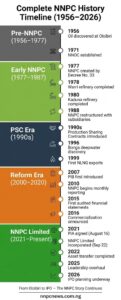
Major Reforms Timeline
Year
Reform
Key Change
1977
NNPC created
Merged NNOC and Ministry of Mines and Power
1988
Restructuring
Created specialized subsidiaries (NPDC, Refining, Marketing, PPMC)
1990s
PSCs introduced
Opened deepwater Nigeria, changed NNPC’s role
1999
NLNG project
Commercialized gas, first exports
2007
PIB introduced
Started 14-year reform process
2010
Monthly reporting
First regular public disclosures
2015
First audited statements
Transparency breakthrough
2016
Commercialization announced
Set stage for PIA
2021
PIA signed
Fundamental restructuring of sector
2021
NNPC Limited incorporated
Old NNPC dissolved, new company created
2022
Asset transfer completed
Legal transition finalized
2025
Leadership overhaul
New board and GCEO appointed
2026
Executive Order
Revenue remittance rules changed
2026
IPO planning
Public listing considered
Complete NNPC History Timeline (1956–2026)
What the Timeline Teaches
Reform Takes Decades
The journey from the 1977 creation of NNPC to the 2021 PIA is 44 years. The PIB alone took 14 years. Real reform doesn’t happen overnight. It takes persistence, pressure, and sometimes, a generation of work.
Transparency Is Hard-Won
Monthly reporting began in 2010. Audited accounts came in 2015. The PIA made both mandatory in 2021. Each step was fought for. None came easily.
Incremental Progress Matters
Not every reform was a grand legislative overhaul. Monthly reporting in 2010 didn’t fix everything. But it built momentum. It created expectations. It made the next step possible.
The Work Continues
The PIA wasn’t the end. It was the beginning. The 2025 leadership overhaul, the 2026 Executive Order, and the IPO planning show that reform is ongoing. NNPC Limited today is not the final version. It’s a work in progress.
The difference between NNPC and NNPC Limited will continue to evolve as more reforms come.
The Conclusion
The timeline of major NNPC reforms spans nearly five decades. It begins with the creation of NNPC in 1977 and continues through the 1988 restructuring, the introduction of PSCs in the 1990s, the NLNG project in 1999, and the transparency milestones of 2010 and 2015.
The 2016 commercialization announcement set the stage for the PIA, which was finally passed in 2021. NNPC Limited was incorporated later that year, and the asset transfer was completed in 2022.
Recent reforms include the 2025 leadership overhaul, the 2026 Executive Order on revenue remittance, and IPO planning. Each reform built on what came before. None was the final word.
The timeline shows that reform is possible, but it takes time. The work continues.
Last updated: April 2026. Information based on Petroleum Industry Act 2021 provisions, NNPC historical records, and official government communications.