
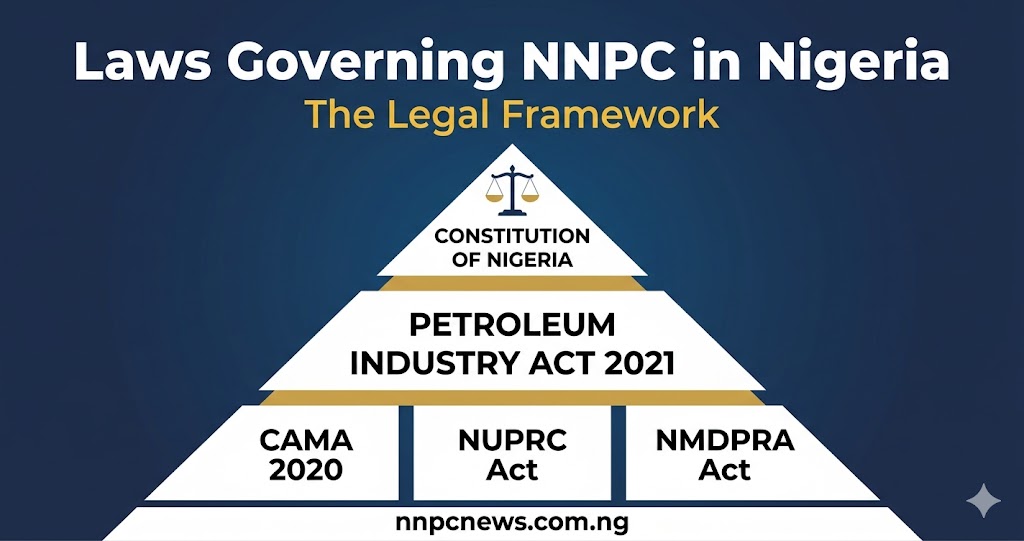
If you want to understand NNPC, you need to understand the laws that created it, shaped it, and now govern it.
For over four decades, one law was enough. The NNPC Act of 1977 defined everything — what NNPC could do, how it was structured, who it answered to. It was a simple framework for a government agency.
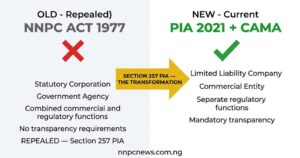
Then came the Petroleum Industry Act of 2021. It didn’t just amend the old law. It repealed it. Section 257 of the PIA explicitly abolished the Nigerian National Petroleum Corporation established under the NNPC Act.
In its place, a new company. NNPC Limited. Registered under the Companies and Allied Matters Act. Governed by a different set of rules entirely.
Here’s the full framework of laws that govern NNPC today — and how we got here.
The Constitution of the Federal Republic of Nigeria
Ownership of Petroleum Resources
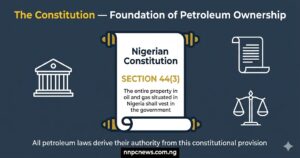
The Constitution vests ownership of petroleum resources in the federal government. Section 44(3) provides that the entire property in oil and gas situated in Nigeria shall vest in the government.
This is the foundation. Everything else — the NNPC Act, the PIA, the regulatory agencies — rests on this constitutional provision. The government owns the resources. It can create institutions to manage them.
Legislative Authority
The Constitution grants the National Assembly power to make laws for the petroleum industry. This authority enables Parliament to enact legislation governing NNPC and the sector.
Federal laws enacted under this constitutional authority bind all persons and entities operating in the industry.
The Petroleum Industry Act 2021
The Overarching Framework
The Petroleum Industry Act 2021 is now the primary legislation governing Nigeria’s petroleum sector. It replaced multiple older laws, including the NNPC Act and the Petroleum Act.
The PIA fundamentally restructured the industry. It created new regulatory agencies, introduced new fiscal terms, and transformed NNPC from a statutory corporation into a limited liability company.
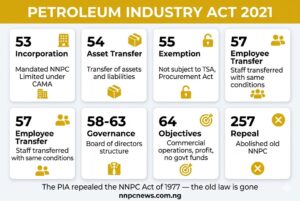
Section 53: Incorporation of NNPC Limited
Section 53 mandated the incorporation of NNPC Limited. It required the Minister of Petroleum Resources to incorporate the company under the Companies and Allied Matters Act within six months of the Act’s commencement.
This section also specifies the initial shareholding structure. The Ministry of Finance Incorporated and the Ministry of Petroleum Incorporated each hold one share on behalf of the federation.
If you’re trying to understand what NNPC Limited is under the Petroleum Industry Act, Section 53 is where to start.
Section 54: Transfer of Assets and Liabilities
Section 54 provides for the transfer of assets and liabilities from the old NNPC to NNPC Limited. The Minister of Petroleum and Minister of Finance were given 18 months to determine exactly what gets transferred.
If they didn’t complete the transfer within 18 months, everything was deemed automatically transferred. The law didn’t allow bureaucracy to block the transition.
Section 55: Exemption from Other Laws
This section specifies that NNPC Limited is not subject to the provisions of the NNPC Act or other laws applicable to government agencies.
The company operates under the Companies and Allied Matters Act like any other commercial entity. The Fiscal Responsibility Act, the Public Procurement Act, and the Treasury Single Account do not apply to its operations.
Section 57: Transfer of Employees
Section 57 transferred all employees of NNPC and its subsidiaries to NNPC Limited with the same or similar conditions of service they had before. This ensured continuity during the transition.
Sections 58–63: Governance Structure
These sections establish the governance framework for NNPC Limited. They require a board of directors, define the composition, and set out responsibilities.
The board includes:
- A Non-Executive Chairman
- A Group Chief Executive Officer
- A Chief Financial Officer
- Ministry representatives
- Six non-executive members, one from each geo-political zone
If you’re interested in the NNPC board of directors and their roles, Sections 58–63 provide the legal foundation.
Section 64: Objectives of NNPC Limited
Section 64 lists the objectives of NNPC Limited. The primary objective is to carry out petroleum operations on a commercial basis, profitably and efficiently, without recourse to government funds.
Ten specific objectives flesh out what this means in practice — from acting as concessionaire for production contracts to engaging in renewable energy and ensuring national energy security.
The objectives and mandate of NNPC are now clearly defined in law.
Section 257: Repeal of NNPC Act
Section 257 explicitly abolished the Nigerian National Petroleum Corporation established under the NNPC Act. The old agency ceased to exist.
NNPC Limited is the successor. But it’s a different legal animal entirely.
The Companies and Allied Matters Act 2020
Registration and Legal Status
NNPC Limited is registered with the Corporate Affairs Commission under the Companies and Allied Matters Act. This is the same law that governs Dangote Cement, MTN Nigeria, and every other company in the country.
Registration under CAMA means NNPC Limited has a memorandum and articles of association. It has a board of directors. It has shareholders. It must follow company law.
Corporate Governance Requirements
CAMA sets out requirements for company directors, meetings, and financial reporting. NNPC Limited must hold annual general meetings and maintain statutory records.
The Act requires companies to prepare annual financial statements and appoint auditors. NNPC Limited complies with these requirements as part of its corporate obligations.
Shareholder Rights
CAMA defines the rights and obligations of shareholders. As the sole shareholder, the federal government exercises rights under the Act through its nominee entities.
Shareholder rights include approval of financial statements, appointment of directors, and declaration of dividends.
If you’re curious about who owns NNPC Limited, CAMA provides the legal framework for understanding shareholding.

The Nigerian Upstream Petroleum Regulatory Commission Act (Within PIA)
Establishment of NUPRC
The PIA established the Nigerian Upstream Petroleum Regulatory Commission as an independent regulator for upstream activities. This includes exploration, production, and development of oil and gas.
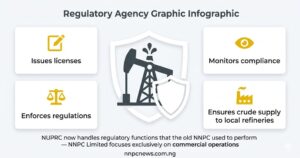
The Commission issues licenses, monitors compliance, and enforces regulations. It also ensures crude supply to local refineries.
Relationship with NNPC Limited
NUPRC now handles regulatory functions that the old NNPC used to perform. NNPC Limited focuses exclusively on commercial operations.
Knowing who regulates NNPC now means understanding NUPRC’s role.
The Nigerian Midstream and Downstream Petroleum Regulatory Authority Act (Within PIA)
Establishment of NMDPRA
The PIA established the Nigerian Midstream and Downstream Petroleum Regulatory Authority to regulate midstream and downstream activities. This includes pipelines, refining, storage, transportation, and marketing.
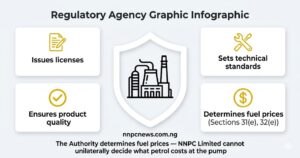
The Authority issues licenses, sets technical standards, and ensures product quality.
Price Determination
Sections 31(e) and 32(e) of the PIA place responsibility for fixing petroleum product prices with the NMDPRA, not NNPC Limited.
The company cannot unilaterally decide what petrol costs at the pump.
Distribution Oversight
Section 32(h) gives the Authority responsibility for distribution of petroleum products. Independent marketers can purchase directly from refineries on their own terms. NNPC Limited cannot impose itself as the sole distributor.
The Petroleum Act (Cap P10, Laws of the Federation of Nigeria, 2004)
Historical Framework
The Petroleum Act provided the overarching legal framework for the petroleum industry before the PIA. It governed exploration, production, transportation, and marketing.
The Act empowered the Minister of Petroleum Resources to grant licenses and leases for petroleum operations.
Transition to PIA
The Petroleum Industry Act has largely superseded the Petroleum Act. Many provisions have been replaced by the new legislation.
However, some transitional provisions preserve continuity during implementation. The Petroleum Act remains relevant for understanding the historical context of NNPC’s operations.
The NNPC Act (Repealed)
What It Was
The NNPC Act was originally enacted as Decree No. 33 of 1977. It established the Nigerian National Petroleum Corporation and defined its powers and functions.
For over four decades, this was the primary law governing NNPC. It made NNPC a statutory corporation, a government agency, not a company.
Why It Was Repealed
The old NNPC Act combined commercial and regulatory functions. It gave NNPC powers that should have been separated. It lacked transparency requirements. It didn’t provide for commercial discipline.
Section 257 of the PIA explicitly abolished the corporation established under the NNPC Act. The old law is gone.
If you’re trying to understand the difference between NNPC and NNPC Limited, the repeal of the NNPC Act and the passage of the PIA is the legal turning point.
Other Relevant Laws
Nigerian Oil and Gas Industry Content Development Act 2010
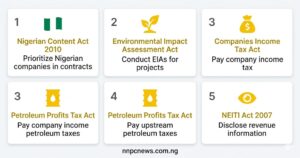
This Act requires NNPC and its partners to prioritize Nigerian companies in contracts. It sets minimum thresholds for local participation in petroleum operations.
NNPC must ensure that its activities comply with local content requirements. The Nigerian Content Development and Monitoring Board oversees implementation.
Environmental Impact Assessment Act
This Act requires environmental impact assessments for petroleum projects. NNPC must conduct EIAs before developing new facilities or expanding existing ones.
The assessment process evaluates potential environmental effects and mitigation measures.
Companies Income Tax Act
NNPC Limited is subject to company income tax under this Act. It must file tax returns and pay taxes on its profits like other Nigerian companies.
The tax liability applies to income from all sources including petroleum operations.
Petroleum Profits Tax Act
This Act governs taxation of upstream petroleum operations. It applies to NNPC Limited’s production activities and joint venture interests.
The Act provides for tax rates, allowable deductions, and assessment procedures.
NEITI Act 2007
The NEITI Act establishes the Nigeria Extractive Industries Transparency Initiative. It requires disclosure of revenues from extractive industries including petroleum.
NNPC must provide information to NEITI for audit and reporting purposes. This supports transparency in the management of petroleum revenues.
Key Takeaways
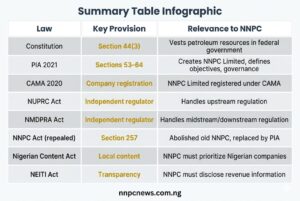
| Law | Key Provision | Relevance to NNPC |
|---|---|---|
| Constitution | Section 44(3) | Vests petroleum resources in federal government |
| PIA 2021 | Sections 53–64 | Creates NNPC Limited, defines objectives, governance |
| CAMA 2020 | Company registration | NNPC Limited registered under CAMA, not special law |
| NUPRC Act | Independent regulator | Handles upstream regulation previously done by NNPC |
| NMDPRA Act | Independent regulator | Handles midstream/downstream regulation |
| NNPC Act (repealed) | Section 257 | Abolished old NNPC, replaced by PIA |
| Nigerian Content Act | Local content | NNPC must prioritize Nigerian companies |
| NEITI Act | Transparency | NNPC must disclose revenue information |
Conclusion
The legal framework governing NNPC has fundamentally changed. For 44 years, the NNPC Act of 1977 was the primary law. It created a statutory corporation, a government agency with combined commercial and regulatory functions.
The Petroleum Industry Act 2021 repealed that law. It created NNPC Limited, a limited liability company registered under the Companies and Allied Matters Act. The PIA established separate regulatory agencies, introduced transparency requirements, and mandated commercial operations.
Today, NNPC Limited is governed by multiple laws: the PIA, CAMA, tax laws, local content laws, and transparency laws. The old framework is gone. The new one is still evolving.
Understanding the laws that govern NNPC is essential for understanding what the company can do, how it must operate, and who holds it accountable.
Official sources for verification:
- • Petroleum Industry Act 2021 on the FAO Legal Database
- • Corporate Affairs Commission (CAC) Official Website
Last updated: April 2026. Information based on Petroleum Industry Act 2021 provisions, Companies and Allied Matters Act, and official government communications.