
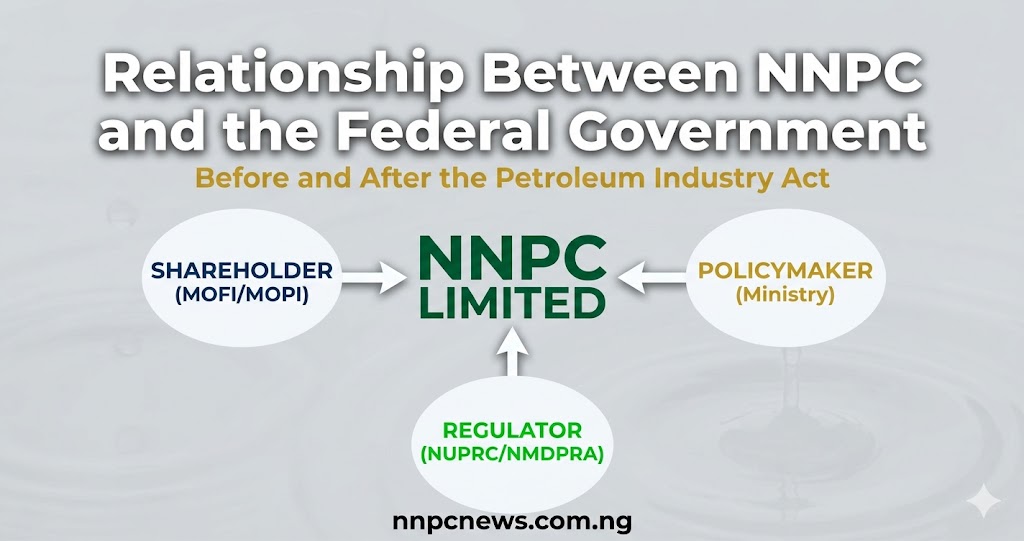
The relationship between NNPC and the federal government has changed more in the last five years than in the previous four decades.
Before 2021, the relationship was simple: NNPC was a government agency. The minister gave orders. NNPC followed them. The lines were direct but blurry. Conflicts of interest were everywhere.
After the Petroleum Industry Act, everything changed. NNPC became a company. The government became a shareholder. The minister stopped giving orders. The board started making decisions.
But the government still owns NNPC Limited completely. It appoints the board. It receives dividends. It sets the policy framework.
Here’s how the relationship works now, how it’s different from before, and what it means for accountability.
The Short Version
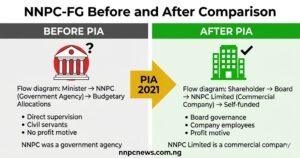
Before the PIA, NNPC was a government agency. It was directly supervised by the Minister of Petroleum Resources. It received budgetary allocations. Its employees were civil servants.
After the PIA, NNPC Limited is a commercial company registered under the Companies and Allied Matters Act. It is wholly owned by the federal government through two shareholder entities: MOFI and MOPI.
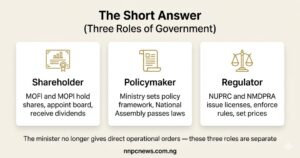
The government now relates to NNPC Limited in three ways: as shareholder, as policymaker, and as regulator. These roles are separate. The minister no longer gives direct operational orders.
If you’re trying to understand what NNPC Limited is under the Petroleum Industry Act, the relationship with the federal government is the key.
Before the PIA: Direct Government Control
NNPC as a Government Agency
The old NNPC was a statutory corporation established by Decree No. 33 of 1977. It was a government agency, not a company.
This meant NNPC was part of the government apparatus. It operated under civil service rules. It received budgetary allocations from the National Assembly. Its employees were civil servants.
The difference between NNPC and NNPC Limited starts here — one was a government agency, the other is a company.
Ministerial Supervision
The Minister of Petroleum Resources had direct supervisory authority over NNPC. Major decisions required ministerial approval. The minister could give orders, and NNPC followed them.
The board, when it existed, served mostly in an advisory capacity. Real power sat with the minister.
Combined Roles
The old NNPC both participated in the industry and regulated it. This dual role created conflicts. The government was both owner and referee. The lines were blurred.
Knowing who regulates NNPC under the old system meant understanding that NNPC regulated itself to a significant degree.
Budgetary Allocations
NNPC received annual budgetary allocations from the federal government. Its operations were funded through appropriations approved by the National Assembly.
This meant NNPC didn’t need to make profit to survive. It got money regardless of performance.
After the PIA: A New Relationship
NNPC Limited as a Commercial Company
NNPC Limited is now a limited liability company registered under the Companies and Allied Matters Act. It is not a government agency. It is a company.
The company operates under company law, not civil service rules. Its employees are company staff, not civil servants. It is funded through internally generated revenue, not budgetary allocations.
The Government as Shareholder
The government is the sole shareholder through two entities:
- Ministry of Finance Incorporated (MOFI) — holds one share
- Ministry of Petroleum Incorporated (MOPI) — holds one share
The NNPC ownership structure under Nigerian law is now formal and clear. The government owns the company, but through shares, not direct statute.
The Government as Policymaker
The federal government still sets petroleum policy. The Ministry of Petroleum Resources develops policy frameworks. The President provides strategic direction.
But policy is implemented through regulation, not direct orders. NNPC Limited must comply with regulations like any other industry participant.
The Government as Regulator
Through NUPRC and NMDPRA, the government regulates NNPC Limited’s operations. These agencies are independent. They do not take orders from NNPC Limited or the Ministry in operational matters.
If you’re curious about who regulates NNPC, the answer is these independent agencies, not the minister directly.
The Three Roles of Government
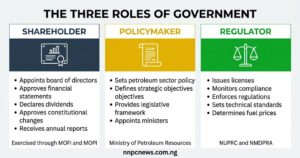
Role 1: Shareholder
As shareholder, the government:
- Appoints the board of directors
- Approves financial statements
- Declares dividends
- Approves major constitutional changes
- Receives annual reports
These rights are exercised through MOFI and MOPI at general meetings.
Role 2: Policymaker
As policymaker, the government:
- Sets petroleum sector policy
- Defines strategic objectives
- Provides legislative framework
- Appoints ministers
The Ministry of Petroleum Resources leads policy development. The National Assembly passes laws.
Role 3: Regulator
As regulator, the government through NUPRC and NMDPRA:
- Issues licenses
- Monitors compliance
- Enforces regulations
- Sets technical standards
- Determines fuel prices
These functions are independent of the shareholder role. The regulator does not take orders from the shareholder.
How the Relationship Has Changed
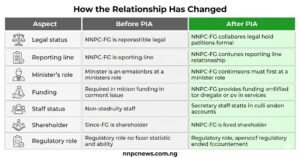
| Aspect | Before PIA | After PIA |
|---|---|---|
| Legal status | Government agency | Commercial company |
| Reporting line | Direct to minister | Reports to board |
| Minister’s role | Direct supervision | Policy direction only |
| Funding | Budgetary allocations | Self-funded through revenue |
| Staff status | Civil servants | Company employees |
| Shareholder | Not applicable | Formal shareholder (MOFI/MOPI) |
| Regulatory role | Combined (player and referee) | Separate (regulated entity) |
The Minister’s Role Today
No Direct Operational Orders
The Minister of Petroleum Resources no longer gives direct operational orders to NNPC Limited. The company is managed by its board and management, not by the ministry.
The Group Chief Executive Officer reports to the board, not to the minister. This is a fundamental change.
If you’re tracking leadership, knowing who is the GCEO of NNPC means understanding that the GCEO answers to the board, not the minister.
Policy Direction
The minister still provides policy direction. This includes setting strategic priorities, developing legislation, and representing Nigeria in international petroleum forums.
But policy is implemented through regulation and law, not direct orders to NNPC Limited.
Board Appointments
The President appoints the board of NNPC Limited, typically on the advice of the minister. The April 2025 leadership changes demonstrated this process.
President Tinubu appointed Bayo Ojulari as GCEO and Ahmadu Musa Kida as board chairman. This was an exercise of shareholder power, not ministerial supervision.
What This Means for Accountability
Clearer Lines
The separation of roles — shareholder, policymaker, regulator — creates clearer lines of accountability. It’s easier to see who is responsible for what.
If NNPC Limited performs poorly, the board and management are accountable. If policy fails, the minister is accountable. If regulation fails, the regulators are accountable.
Transparency
The PIA requires NNPC Limited to publish audited financial statements annually. The NNPC financial statements explained show how the company is performing.
This transparency enables the government, as shareholder, to hold management accountable. It also enables the public to see what is happening.
Reduced Political Interference
The separation of roles is designed to reduce political interference. The minister no longer gives direct operational orders. The board makes commercial decisions.
Whether this works in practice remains to be seen. Political pressure can still be applied through shareholder directives or policy changes. But the legal framework is stronger.
Areas of Tension
Policy vs Commercial Interest
Sometimes policy objectives and commercial interests conflict. The government may want NNPC Limited to keep fuel prices low, but that may hurt profitability.
The PIA tries to resolve this by separating roles. The government sets policy through legislation and regulation. NNPC Limited operates commercially within that framework.
Shareholder vs Regulator
The government is both shareholder and regulator. This creates potential conflicts. As shareholder, it wants NNPC Limited to be profitable. As regulator, it must enforce rules impartially.
The PIA addresses this by making NUPRC and NMDPRA independent. They do not take orders from the shareholder.
Strategic Direction
The government sets strategic direction through policy. But NNPC Limited’s board is responsible for commercial strategy. Where do these overlap?
The answer is in the law. The PIA gives NNPC Limited specific objectives. The government cannot unilaterally change those objectives without legislation.
The objectives and mandate of NNPC are defined in Section 64 of the PIA. They can only be changed by amending the Act.
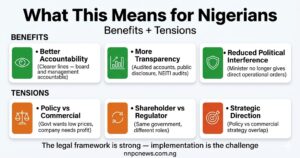
What This Means for Nigerians
Better Accountability
The new relationship structure should lead to better accountability. Clearer lines mean it’s easier to see who is responsible for what.
If NNPC Limited fails to perform, the board and management can be replaced. The April 2025 leadership overhaul was an example of this accountability in action.
More Transparency
The PIA’s transparency requirements mean Nigerians can see what is happening with their oil money. Audited accounts, public disclosure, and NEITI audits all contribute.
The NNPC and NEITI reports explained show how this transparency works.
Reduced Political Interference
In theory, reduced political interference should lead to better commercial decisions. The board can focus on profitability, not political pressure.
But this is still evolving. The system is new. Whether it fully achieves this goal remains to be seen.
The Conclusion
The relationship between NNPC and the federal government has fundamentally changed. Before the PIA, NNPC was a government agency directly supervised by the Minister of Petroleum Resources. It received budgetary allocations. Its employees were civil servants.
After the PIA, NNPC Limited is a commercial company registered under the Companies and Allied Matters Act. It is wholly owned by the federal government through MOFI and MOPI. The government now relates to NNPC Limited in three distinct roles: as shareholder, as policymaker, and as regulator.
The minister no longer gives direct operational orders. The board makes commercial decisions. Regulators enforce rules independently. The lines are clearer. Accountability is stronger.
But the system is still evolving. Tensions remain between policy objectives and commercial interests, between shareholder and regulator roles, and between strategic direction and commercial strategy. The legal framework is strong. Implementation is the challenge.
For Nigerians, the new relationship should mean better accountability, more transparency, and reduced political interference. The work continues.
Official sources for verification:
Last updated: April 2026. Information based on Petroleum Industry Act 2021 provisions, NNPC financial reports, and official government communications.