
If you’ve been following Nigerian oil and gas news, you’ve heard about the Petroleum Industry Act. You’ve heard about NNPC Limited. But what’s the connection between them?
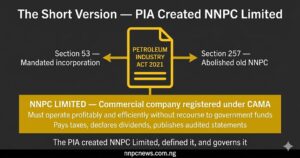
The short answer: the PIA created NNPC Limited. Section 53 of the Act mandated the incorporation of the company. Section 257 abolished the old NNPC. One law, one transformation.
But the PIA did more than just change NNPC’s name. It restructured the entire petroleum sector. It created new regulatory agencies. It introduced new fiscal terms. It mandated transparency. And at the center of all these changes sits NNPC Limited — a commercial company, not a government agency.
Here’s how the Petroleum Industry Act works, what it means for NNPC Limited, and why it matters.
The Short Version
The Petroleum Industry Act 2021 is the law that fundamentally restructured Nigeria’s petroleum sector. It replaced multiple older laws, created new regulatory agencies, and transformed NNPC from a statutory corporation into a limited liability company called NNPC Limited.
NNPC Limited is now a commercial entity registered under the Companies and Allied Matters Act. It must operate profitably and efficiently without recourse to government funds. It pays taxes, declares dividends, and publishes audited financial statements.
If you’re trying to understand what NNPC Limited is under the Petroleum Industry Act, the answer is that the PIA created it, defined it, and governs it.
What the PIA Does
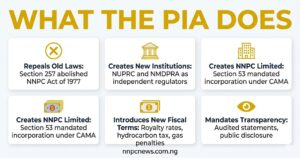
Repeals Old Laws
Section 257 of the PIA explicitly abolished the Nigerian National Petroleum Corporation established under the NNPC Act of 1977. The old law is gone. The old agency is gone.
The PIA also replaced the Petroleum Act and other sector-specific legislation. It consolidated multiple laws into one comprehensive framework.
Creates New Institutions
The PIA established two new regulatory agencies:
- Nigerian Upstream Petroleum Regulatory Commission (NUPRC) — regulates exploration, production, and development
- Nigerian Midstream and Downstream Petroleum Regulatory Authority (NMDPRA) — regulates pipelines, refining, storage, transportation, and marketing
These agencies replaced the Department of Petroleum Resources and other regulatory bodies. They are independent, focused, and separate from commercial operations.
If you’re curious about who regulates NNPC, these agencies are the answer.
Creates NNPC Limited
Section 53 mandated the incorporation of NNPC Limited under the Companies and Allied Matters Act. The Minister of Petroleum Resources was required to incorporate the company within six months of the Act’s commencement.
The old NNPC was dissolved. A new company took its place. Same initials. Completely different legal personality.
Introduces New Fiscal Terms
The PIA introduced new fiscal terms for the petroleum industry. These include:
- New royalty rates for onshore, shallow water, and deepwater operations
- A new hydrocarbon tax regime
- Provisions for gas flaring penalties
- A framework for domestic gas supply obligations
Mandates Transparency
The PIA requires NNPC Limited to publish audited financial statements annually. Section 62 mandates annual audit by an independent, qualified auditor. Section 61 requires board members to discharge responsibilities in accordance with the highest standards of corporate governance.
Transparency is no longer optional. It’s the law.
How the PIA Created NNPC Limited
Section 53: The Incorporation Mandate
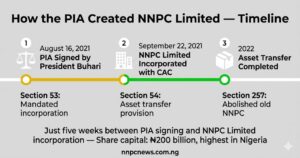
Section 53(1) required the Minister of Petroleum Resources to cause the incorporation of NNPC Limited in consultation with the Minister of Finance.
Section 53(2) specified the initial shareholders: the Ministry of Finance Incorporated (MOFI) and the Ministry of Petroleum Incorporated (MOPI), each holding one share on behalf of the federation.
Section 53(5) added an important restriction: the shares cannot be transferred or mortgaged unless approved by the government and the National Economic Council.
The Timeline
The PIA was signed on August 16, 2021. Just five weeks later, on September 22, 2021, NNPC Limited was incorporated with the Corporate Affairs Commission.
The company was registered with a share capital of ₦200 billion — the highest in Nigeria at the time. The shares were fully subscribed by the government through MOFI and MOPI.
The Asset Transfer
Section 54 provided for the transfer of assets and liabilities from the old NNPC to NNPC Limited. The Minister of Petroleum and Minister of Finance were given 18 months to determine exactly what gets transferred.
If they didn’t complete the transfer within 18 months, everything was deemed automatically transferred. The law didn’t allow bureaucracy to block the transition.
The transfer was completed in 2022. The old NNPC ceased to exist.
What the PIA Requires of NNPC Limited
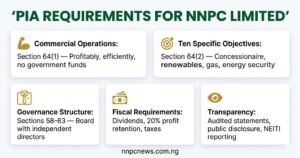
Commercial Operations
Section 64(1) requires NNPC Limited to carry out petroleum operations on a commercial basis, profitably and efficiently, without recourse to government funds.
This is the core mandate. The company must make profit. It cannot go back to government for funding.
Specific Objectives
Section 64(2) lists ten specific objectives:
- Carry out petroleum operations on a commercial basis
- Act as concessionaire for all production contracts
- Remit proceeds to government less management fee and Frontier Exploration Fund
- Carry out test marketing to determine value of crude oil
- Manage production sharing contracts
- Engage in renewables and other energy investments
- Promote domestic gas utilization
- Maintain the role of NNPC
- Carry out tasks requested by the Commission
- Engage in activities that ensure national energy security
The objectives and mandate of NNPC are now clearly defined in law.
Governance Structure
Sections 58–63 establish the governance framework. NNPC Limited must have a board of directors with:
- A Non-Executive Chairman
- A Group Chief Executive Officer
- A Chief Financial Officer
- Ministry representatives
- Six non-executive members, one from each geo-political zone
The board provides strategic oversight. Management handles day-to-day operations. The GCEO reports to the board, not to the minister.
Fiscal Requirements
NNPC Limited must:
- Declare dividends to shareholders
- Retain 20 percent of profits as retained earnings
- Pay taxes under the Companies Income Tax Act
- Pay royalties and petroleum profits tax on upstream operations
Transparency Requirements
NNPC Limited must:
- Publish audited financial statements annually
- Submit to audit by an independent, qualified auditor
- Disclose revenues, costs, and profits
- Provide information to NEITI for audit and reporting
The NNPC financial statements explained show how these transparency requirements work in practice.
What the PIA Changed
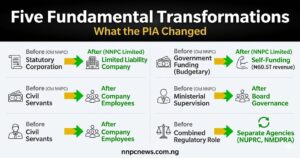
From Statutory Corporation to Limited Liability Company
Before the PIA, NNPC was a statutory corporation. It existed because the NNPC Act said so. Its powers, structure, and existence came from that law.
After the PIA, NNPC Limited is a limited liability company. It’s registered under the Companies and Allied Matters Act, like every other company in Nigeria.
The difference between NNPC and NNPC Limited starts here.
From Government Funding to Self-Funding
Before the PIA, NNPC received budgetary allocations from the federal government. It didn’t need to make profit to survive.
After the PIA, NNPC Limited must fund its operations through internally generated revenue and commercial borrowing. In 2025, it recorded total revenue of ₦60.5 trillion and profit after tax of ₦3.76 trillion.
From Civil Servants to Company Employees
Before the PIA, NNPC employees were civil servants. Their terms followed public service rules. Compensation was determined by government pay scales.
After the PIA, NNPC Limited employees are company staff. Section 57 transferred existing employees with the same conditions, but over time, employment terms will shift toward company norms.
From Ministerial Supervision to Board Governance
Before the PIA, the Minister of Petroleum Resources had direct supervisory authority. Major decisions required ministerial approval.
After the PIA, NNPC Limited is governed by a board of directors. The GCEO reports to the board, not to the minister. The April 2025 leadership overhaul demonstrated this new model.
If you’re tracking leadership, knowing who is the GCEO of NNPC matters for understanding how this new governance model works.
From Combined to Separate Regulatory Functions
Before the PIA, NNPC both participated in the industry and regulated it. It was both player and referee.
After the PIA, NNPC Limited focuses exclusively on commercial operations. Regulation is handled by NUPRC and NMDPRA.
What the PIA Didn’t Change
Government Ownership
Despite the transformation, NNPC Limited is still wholly owned by the federal government. The government is the sole shareholder through MOFI and MOPI.
This isn’t privatization. It’s commercialization. The government still controls the company. But control is now exercised through shareholding and board appointments, not direct ministerial supervision.
If you’re curious about who owns NNPC Limited, the answer is still the federal government.
Strategic Importance
NNPC Limited remains strategically important to Nigeria’s economy. Oil and gas revenue still dominates government income. Fuel supply still affects every Nigerian.
The company’s mandate includes ensuring national energy security. That strategic role hasn’t changed.
Employee Continuity
Section 57 transferred all employees of NNPC and its subsidiaries to NNPC Limited with the same or similar conditions of service they had before. The transition preserved continuity.
The Results So Far
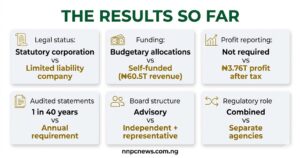
| Metric | Before PIA (2019) | After PIA (2025) |
|---|---|---|
| Legal status | Statutory corporation | Limited liability company |
| Funding | Budgetary allocations | Self-funded (₦60.5T revenue) |
| Profit reporting | Not required | ₦3.76T profit after tax |
| Audited statements | 1 in 40 years | Annual requirement |
| Board structure | Advisory | Independent + representative |
| Regulatory role | Combined | Separate agencies |
What’s Next
IPO Planning
NNPC Limited is moving closer to a historic public listing, with plans to offer shares to investors on major global exchanges. The company is considering listings on the New York Stock Exchange and the London Stock Exchange.
This would fundamentally change the ownership structure. Nigerians and institutional investors would be able to buy shares directly. The government would no longer be the sole shareholder.
Continued Reforms
The PIA wasn’t the end. It was the beginning. The 2025 leadership overhaul and the 2026 Executive Order on revenue remittance show that reform is ongoing.
The work continues.
Conclusion
The Petroleum Industry Act 2021 created NNPC Limited. Section 53 mandated the incorporation of the company. Section 257 abolished the old NNPC.
The PIA fundamentally restructured Nigeria’s petroleum sector. It created new regulatory agencies, introduced new fiscal terms, and transformed NNPC from a statutory corporation into a limited liability company.
NNPC Limited is now a commercial entity registered under the Companies and Allied Matters Act. It must operate profitably and efficiently without recourse to government funds. It pays taxes, declares dividends, and publishes audited financial statements.
The PIA was the most fundamental reform in Nigerian oil and gas history. NNPC Limited is its most important creation. The work continues.
Official sources for verification:
Last updated: April 2026. Information based on Petroleum Industry Act 2021 provisions, NNPC financial reports, and official government communications.